


The astronomical unit (symbol AU) is a unit of length, roughly the distance from Earth to the Sun. However, that distance varies as Earth orbits the Sun, from a maximum (aphelion) to a minimum (perihelion) and back again once a year. Originally conceived as the average of Earth's aphelion and perihelion, it is now defined as exactly 149597870700 metres (about 150 million kilometres, or 93 million miles).
Lunar distance is as a unit of measure in astronomy. It is the average distance from the center of Earth to the center of the Moon. Lunar distance is also called Earth-Moon distance, Earth–Moon characteristic distance, or distance to the Moon, and commonly indicated with LD. The mean semi-major axis has a value of 384,402 km (238,856 mi).
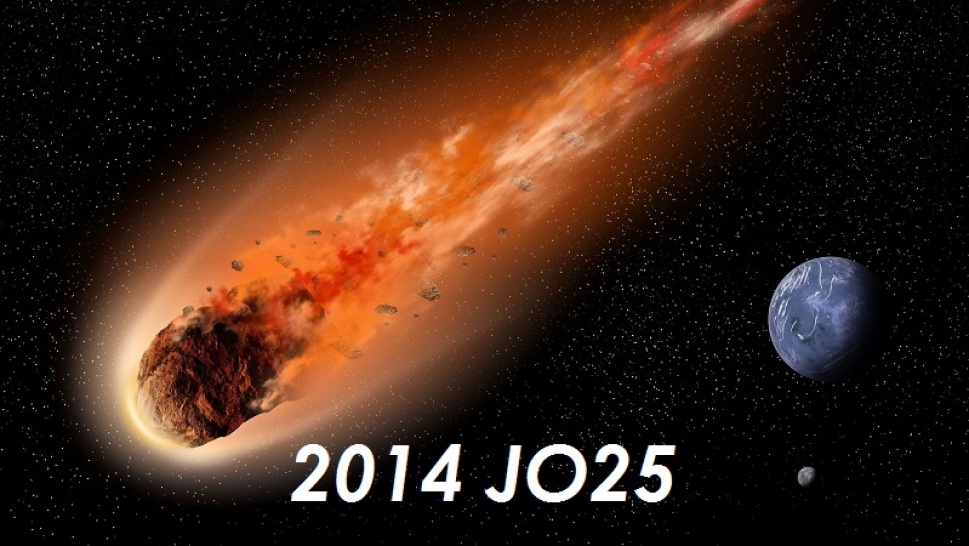
A relatively large near-Earth asteroid discovered nearly three years ago (thats why he got 2014 prefix) will fly safely past Earth on April 19 at a distance of about 1.1 million miles (1.8 million kilometers), or about 4.6 times the lunar distance. Although there is no possibility for the asteroid to collide with our planet, this will be a very close approach for an asteroid of this size.
The asteroid, known as 2014 JO25, was discovered in May 2014 by astronomers at the Catalina Sky Survey near Tucson, Arizona -- a project of NASA's NEO Observations Program in collaboration with the University of Arizona. Contemporary measurements by NASA's NEOWISE mission indicate that the asteroid is roughly 2,000 feet (650 meters) in size, and that its surface is about twice as reflective as that of the moon. At this time very little else is known about the object's physical properties, even though its trajectory is well known.

The asteroid will approach Earth from the direction of the sun and will become visible in the night sky after April 19. It is predicted to brighten to about magnitude 11, when it could be visible in small optical telescopes for one or two nights before it fades as the distance from Earth rapidly increases.
The April 19 encounter provides an outstanding opportunity to study this asteroid, and astronomers plan to observe it with telescopes around the world to learn as much about it as possible. Radar observations are planned at NASA's Goldstone in California and the National Science Foundation's Arecibo Observatory in Puerto Rico, and the resulting radar images could reveal surface details as small as a few meters.
Share the News