

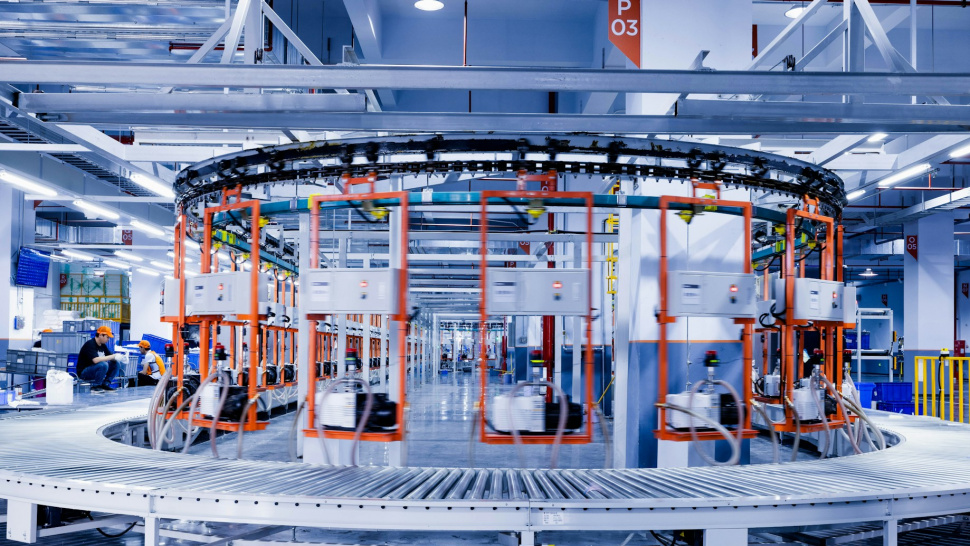

The transformation brought by Industry 4.0 has globally impacted the traditional manufacturing by introducing and incorporating the Digital technologies to build fully automated, data derived and inter-connected smart factories. This advanced manufacturing paradigm focuses on the integration of IoT, AI and Cyber Physical systems to boost the overall productivity and flexibility of the factories. Smart factories allow for real time decision making and market responsive adaptive manufacturing processes along with seamless machine communication and programmable workflows. Digitalization is allowing the manufacturers to optimize their supply chains, reduce downtime and improve product customization. Moreover, smart manufacturing helps in meeting the sustainability objectives by reducing overall energy and material used. Industry 4.0 focus is geared towards improving global competitiveness and productivity which is why every govenment and large corporation has started investing towards IoT and AI integration. As a result, global intelligent manufacturing systems built on smart factories are the new innovation and designed to reshape the entire industrial value chains. This comes with the added benefit of redefining the value of the human workers through automated collaboration. As the new era of production, smart factories are efficient, sustainable and resilient against geo-political shocks.
As per GMI Research, the Smart Factory Market size is estimated to reach USD 216.9 billion in 2030
Integration of IoT, AI, and Robotics in Factory Operations
The integration of AI, robotics, and IoT devices focuses on the transformation of smart factories and the seamless interconnected manufacturing ecosystems that accompany the innovation. IoT devices transmit, record, and monitor the data in real time that comes from hundreds of machines, sensors, and production lines. This data integrates or serves digitally as the bedrock within the decision-making frameworks of the factory's autonomous AI. AI analyzes the data gathered and determines how to optimize workflows, predict potential failures, and increase the efficiency of operations. Robotics and collaborative robots (cobots) take over tasks that are either boring, repetitive, or pose risks with greater accuracy and improved safety. These technologies enable production systems that self-regulate, learn, and adapt autonomously without the need of manual input. This paradigm shift in manufacturing systems leads to agile production insights proven with shrinkage in lead times and increased responsiveness to customer demands. IoT devices coupled with AI systems transform the accuracy and investment in primary production and production in general by enabling real time scouting and defect identification and AI driven quality control systems. The whole ecosystem of IoT devices, AI, and robotics eliminates the delay of innovation and use of speculative production and focuses on unyielding efficacy. These advancements in manufacturing and production systems drive the growth of self-sustaining autonomous eco-systems and redefine the boundaries of production.
Digital Twins and Predictive Maintenance to Maximize Efficiency
Digital twins and predictive maintenance are changing the smart factory landscape with their system reliability and manufacturing effectiveness. A digital twin system enables real-time monitoring, simulation, and optimization of factory operations by creating a digital twin of an asset or system. Digital twins are actionable tools for real-time monitoring and analyzing sensor data to gauge equipment condition, production flows, and bottleneck points using AI and the Internet of Things analytics. Predictive maintenance indicates equipment failures and maintenance needs before they happen, reducing downtime and associated maintenance costs. Factories are enabled to work on data-driven projected maintenance, instead of fixed maintenance routines, to maximize asset and equipment life. This results in enhanced productivity, safety, and operational continuity while reducing resource waste. Digital twins also enable the testing of new improvements and sustainability processes without disrupting ongoing real operations. This is the step to be taken to ensure that industries are attaining their sustainability goals. There is an intelligent balance achieved with digital twins and operative resource administration, which is aligning and optimally using foresight analytics. Predictive maintenance and digital twins work in unison to maximize the growth of smart manufacturing. This changes the intersection of performance with predictive analytics to new extremes.



Share the News