

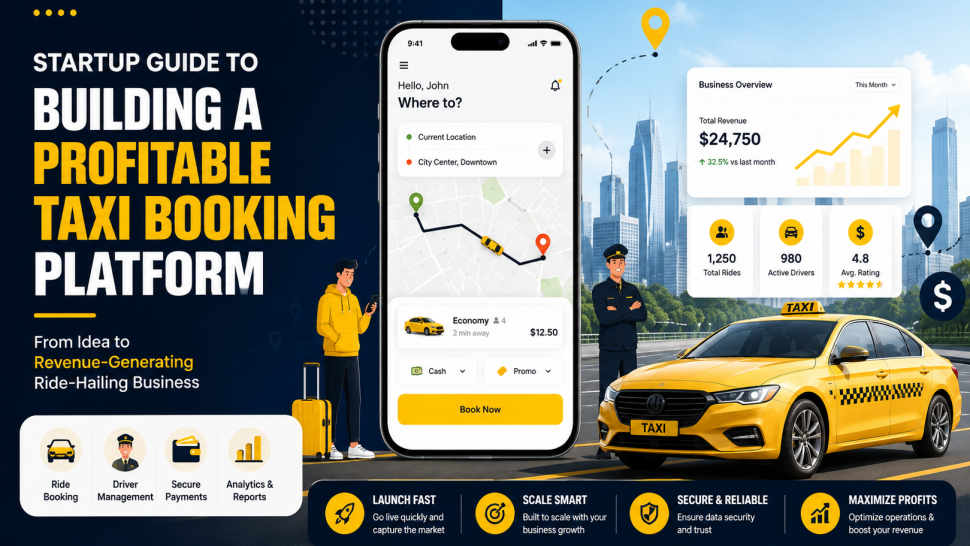

The global ride-hailing market is on track to surpass $230 billion by 2030, and 2026 is one of the most strategically important years to enter it. Smartphone penetration, reliable GPS, and digital payments have permanently changed how people move — and that shift is your startup's opportunity.
Traditional taxi operators are losing riders to app-first platforms every day. Startups that enter in 2026 with the right business model, right features, and right technology can carve out highly profitable regional markets before global giants notice them.
Why ride-hailing works for startups in 2026:
- Asset-light: No vehicles needed with an aggregator model
- Recurring revenue: Commission on every ride compounds fast
- Underserved markets: Tier-2 and Tier-3 cities remain wide open
- Mobile-first: A great app is your entire storefront
- EV tailwinds: Government subsidies in 2026 make green fleets more viable than ever
Business Models
Choosing the right model before you build saves months of costly pivoting. Four proven models dominate in 2026:
- Aggregator Model - You own the platform; drivers bring their vehicles. You earn 15–25% commission per ride. Lowest capex, fastest to scale. Best for: Urban markets with existing licensed drivers.
- Dedicated Fleet Model - You own or lease vehicles and manage drivers directly. Full quality control but high operating cost. Best for: Premium, corporate, or airport transfer services.
- Peer-to-Peer (P2P) Model - Private car owners give rides when convenient. Lower costs but complex regulation. Best for: Carpooling and intercity shared rides.
- Corporate Transportation Model - B2B contracts with enterprises for employee transport, with monthly billing and SLA dashboards. Best for: IT parks, hospitals, and manufacturing campuses.
Market Research and Business Planning
No amount of great technology saves a product launched into the wrong market. Before building in 2026, answer three questions:
Who is your rider? Define age, income, commute habits, and payment preference. This shapes every feature decision you make.
Who is your competition? Study local operators — not just Uber. Map their pricing, driver incentives, and 1-star reviews. Gaps in their service are your opportunity.
What is your USP? Pick one concrete differentiator for 2026:
- Zero-surge guaranteed pricing
- Female-driver option for women passengers
- 80% driver payout (vs. industry average of 75%)
- EV-only green fleet with verified carbon savings
- Sub-5-minute ETA in your launch zone
Essential Features in Taxi App
Your platform is three products: the Passenger App, the Driver App, and the Admin Panel. All three must be excellent in 2026 — riders and drivers have high expectations set by mature incumbents.
Passenger App
- OTP / Social login
- Real-time driver tracking with ETA
- Multi-payment: cards, UPI, wallets, cash
- Fare estimate before booking
- Ride scheduling (up to 7 days ahead)
- SOS emergency alert with live location sharing
- In-app masked calling and chat
- Ratings, trip history, and e-receipts
- Promo codes and referral credits
Driver App
- Fast KYC onboarding (24–48 hour approval)
- Ride request preview (pickup distance, fare, destination)
- Turn-by-turn navigation
- Live earnings dashboard
- Instant payout to bank or wallet
- Performance insights (acceptance rate, rating trend)
- In-app dispute and support
Admin Panel
- Live city-wide operations map
- User and driver management (approve, suspend, verify)
- Surge zone configuration
- Revenue and trip analytics
- Promo campaign management
- Dispute resolution with full ride data audit trail
- Push notification broadcast by segment
Technology Stack for Taxi App Development in 2026
The recommended technology stack for modern taxi apps focuses on speed, scalability, and real-time performance.
- Mobile Apps: React Native or Flutter for cross-platform development.
- Backend: Node.js or Go for handling high user traffic and real-time requests.
- Real-Time Features: WebSockets and Firebase for live ride tracking and instant updates.
- Maps & Navigation: Google Maps API or Mapbox for route optimization and location services.
- Payments: Razorpay for India and Stripe for global transactions.
- Database: PostgreSQL, Redis, and MongoDB for secure and scalable data management.
- Cloud Infrastructure: AWS or Google Cloud for auto-scaling and reliability.
- Push Notifications: Firebase Cloud Messaging (FCM) for real-time alerts.
- Analytics: Mixpanel or Amplitude for user behavior tracking and business insights.
Development Process Of Taxi App Development
1. Requirement Analysis
Define business goals, target audience, and core features. This phase results in a detailed Product Requirements Document (PRD) and MVP feature list.
2. UI/UX Design
Create wireframes, user flows, and interactive prototypes. Designs are tested with real users to ensure a smooth and intuitive experience.
3. Development (Sprint-Based)
The development process is typically divided into sprints, covering modules such as user authentication, maps and location services, ride booking, payment integration, notifications, and the admin panel.
4. API Integrations
Integrate essential third-party services, including maps, payment gateways, OTP verification, push notifications, and analytics tools.
5. QA and Testing
Conduct comprehensive testing, including unit testing, integration testing, load testing for high traffic scenarios, and user acceptance testing (UAT) to ensure reliability.
6. Deployment and Launch
Deploy the application on app stores, configure cloud infrastructure, and execute launch marketing activities to attract initial users and drivers.
7. Revenue Models
Successful taxi platforms in 2026 generate revenue through multiple income streams rather than relying solely on ride commissions.
- Ride Commission (15–25%) – The primary revenue source, earned from every completed ride booked through the platform.
- Surge Pricing (1.5×–3×) – Higher fares during peak demand periods increase revenue while encouraging more drivers to come online.
- Rider Subscriptions – Monthly or yearly ride plans offer discounts and benefits to frequent users, creating predictable recurring revenue.
- Driver Subscriptions – Drivers pay a fixed monthly fee in exchange for lower commission rates and additional platform benefits.
- Cancellation Fees – Charges applied when rides are canceled after the grace period, helping compensate drivers for lost time.
- Corporate Contracts – Provide transportation services to businesses through monthly billing agreements and service-level commitments.
- In-App Advertising – Generate additional income by displaying relevant ads, promotions, or sponsored listings within the app.
- EV Green Premium – Offer eco-friendly ride options with a small premium fee for electric vehicle rides, a growing trend in 2026.
8. Taxi App Development Cost
If you're planning to launch a Taxi Booking App MVP, development costs can start from $5,000 when using a streamlined feature set, cross-platform development, and an experienced offshore development team.
Estimated MVP Cost Breakdown:
- UI/UX Design: $500 – $1,000
- Passenger App (Android & iOS): $1,500 – $2,000
- Driver App (Android & iOS): $1,000 – $1,500
- Admin Panel: $500 – $1,000
- Backend Development: $800 – $1,500
- Third-Party Integrations (Maps, Payments, Notifications): $300 – $700
- Testing & Deployment: $400 – $800
Total MVP Cost: Starting from $5,000
Challenges
Every ride-hailing startup in 2026 hits these walls. Plan for them in advance.
- Chicken-and-Egg (Driver Supply) - Riders won't use an app with no drivers; drivers won't join without riders. Fix: Recruit and guarantee driver earnings 60–90 days before your rider launch. Launch with supply already in place.
- Customer Retention - One bad ride shared on social media undoes weeks of acquisition spend. Fix: Track Day-7 and Day-30 retention weekly. The fastest fix is usually ETA reduction and driver quality enforcement through your ratings system.
- Competing with Uber - Don't fight on price; you'll run out of cash. Fix: Win on geography (markets Uber ignores), segment (corporate B2B, female-only, EV), and local service quality a 100,000-person company cannot match.
- Regulatory Compliance in 2026 - Regulations have tightened significantly. Fix: Obtain an aggregator license, verify all drivers with police clearance, comply with MVA 2019 (amended) data retention requirements, and implement PDPB/GDPR-compliant data handling before launch.
- Scaling Too Fast - Expanding before product-market fit burns runway. Fix: Reach NPS 50+ and Day-30 retention above 40% in your first city before entering a second market. Your cloud infrastructure handles the traffic spike when you do.
Advanced Features
Add these after product-market fit - each directly improves profitability in 2026.
- AI Dispatch - Factors in driver heading, traffic prediction, and acceptance rate history. Reduces average ETA by 20–35% and increases driver trips-per-hour by 15–25%.
- Dynamic Surge Pricing - Machine learning predicts demand spikes (rain, events, Monday rush) and pre-positions driver incentives before the surge hits. Directly amplifies surge revenue.
- Route Optimization - Shortest + fastest route accounting for live traffic. More trips per driver per day = better driver earnings = better retention.
- Fleet Management - For dedicated fleet operators: telematics for fuel monitoring, maintenance alerts, and insurance renewal tracking. Reduces fleet operating cost by 10–15%.
- Ride Scheduling - Recurring bookings with auto-dispatch 30 minutes before pickup. Cancellation rate drops 60–70% vs. on-demand rides.
- EV Charging Waypoints (New in 2026) - For EV fleets, integrate nearest charging station routing into the driver app so low-battery alerts and detours are handled automatically.
Future Trends in 2026 and Beyond
- EV Fleets (Now Mainstream) — India's FAME III subsidies and expanded 2026 charging infrastructure make EV fleet adoption cost-effective right now. A "Green Ride" tier attracts corporate ESG buyers — tying directly into the Corporate Transportation Model.
- AI Automation — In 2026, AI handles automated KYC, support bots, real-time fraud detection, and demand forecasting. Platforms not using AI for operations are already falling behind on unit economics.
- MaaS Integration — Mobility as a Service is going live in Indian metro cities in 2026. Build API-open architecture today to join city-wide MaaS ecosystems as an infrastructure partner, not an afterthought.
- Autonomous Vehicles — Pilot programs are running in select cities in 2026. The booking, dispatch, and payment infrastructure you build now is the same layer that commands an autonomous fleet when public deployments scale.
Why Comfygen?
Comfygen Technologies has delivered 100+ on-demand mobility platforms globally and is one of the most trusted taxi app development company in 2026. Here's what you get:
- Custom taxi app development — built to your specs, not a template
- Uber Clone 2026 — market-ready, white-label, full source code, launched in 4–6 weeks
- End-to-end delivery — design, development, QA, App Store submission, post-launch support
- Scalable architecture — cloud-native, microservices-based, handles 100 to 1,000,000 users
- 12-month support SLA — bug fixes, OS updates, and minor features included
- Transparent pricing — fixed-cost or T&M contracts, no billing surprises
- NDA from day one — your idea is protected
Whether you need a full custom platform or a fast Uber Clone launch, Comfygen has the team, the process, and the 2026-ready tech stack to get you there.
Share the News