

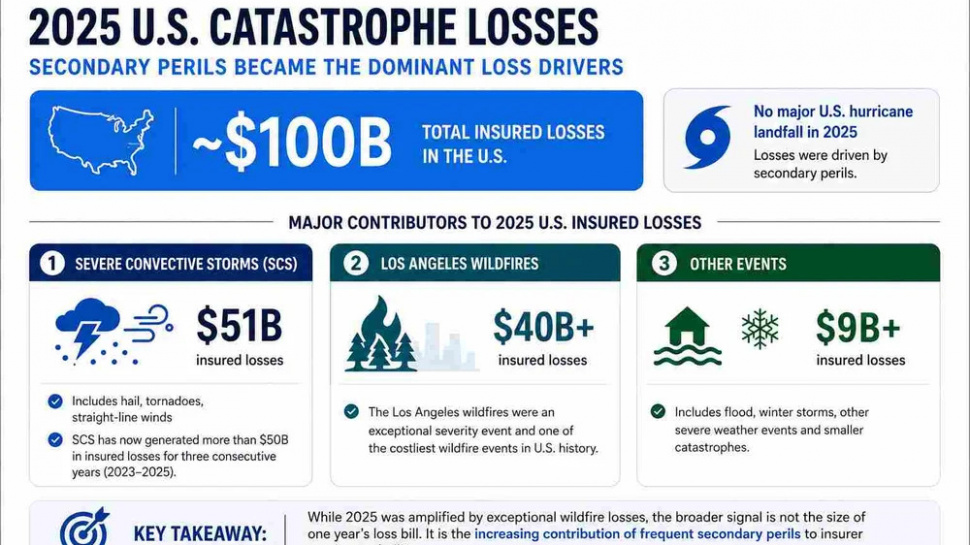

The insurance industry is experiencing a fundamental change in the way catastrophe risks impact portfolios. For decades, catastrophe planning focused mainly on rare, high-severity events such as hurricanes, earthquakes, and major floods. These events created significant losses, but their infrequent nature allowed insurers to prepare using traditional catastrophe models.
Today, the risk environment is becoming more complex. Insurers are facing a growing number of repeated weather-related events that may appear smaller individually but create substantial financial pressure when combined. These changing patterns are making frequency-driven cat losses an important focus area for insurers seeking better risk management strategies.
As secondary perils continue to increase, insurance companies need more advanced approaches to understand exposure, improve underwriting decisions, and maintain portfolio resilience.
The Shift From Severity-Focused Risks to Frequent Events
Traditional catastrophe management strategies were designed around major disasters that could cause billions in losses from a single occurrence. While these events remain a major concern, insurers are now dealing with a different challenge.
Frequent events such as severe storms, hailstorms, wildfires, and localized flooding are occurring more regularly across different regions. These events may not create extreme losses individually, but repeated claims can significantly affect insurer profitability.
This shift requires insurers to expand their focus beyond large catastrophic events and better understand recurring risk patterns.
Understanding Frequency-Driven Cat Losses
Frequency-driven cat losses are losses caused by catastrophe events that occur repeatedly over time. Unlike traditional catastrophes that are defined by extreme severity, frequency-driven events create financial pressure through repeated occurrences.
Examples of these events include:
Severe convective storms affecting multiple areas
Repeated flood events in vulnerable locations
Increasing wildfire incidents
Wind and hail-related property damage
Regional weather disruptions
The challenge is that these risks can accumulate quickly, making them difficult to predict using only traditional historical models.
Why Secondary Perils Are Creating New Challenges
Secondary perils have become one of the biggest concerns for insurers because they are often more difficult to model and manage.
Unlike major catastrophes, these events can happen frequently across different regions. Their cumulative impact can lead to increased claims activity, higher loss ratios, and greater uncertainty in underwriting.
Factors contributing to rising secondary peril challenges include:
Changing climate conditions
Expanding urban development
Increased property values in vulnerable areas
Changing patterns of extreme weather
Insurers must adapt their strategies to account for these evolving risks.
The Limitations of Traditional Catastrophe Models
Catastrophe models remain an important part of insurance risk management. However, relying only on historical data may not provide a complete picture of current exposure conditions.
Historical patterns may not fully capture:
New geographic risk areas
Changing weather behavior
Increasing exposure concentration
Emerging loss trends
Because risk conditions continue to evolve, insurers require more dynamic solutions that provide updated insights.
Improving Risk Visibility Through Advanced Analytics
Managing recurring catastrophe events requires better understanding of where risks exist and how they change over time.
Advanced analytics and technology solutions allow insurers to evaluate:
Exposure concentration
Regional risk trends
Claims patterns
Weather-related indicators
By improving risk visibility, insurers can make more informed decisions about pricing, underwriting, and portfolio management.
The Role of Real-Time Monitoring in Catastrophe Management
Modern catastrophe management increasingly depends on continuous access to updated information. Real-time monitoring solutions help insurers identify changes in exposure conditions before they create unexpected losses.
These solutions can support insurers by providing:
Updated catastrophe intelligence
Faster risk assessments
Improved exposure tracking
Early identification of emerging threats
This proactive approach allows insurers to move beyond reactive loss management.
Strengthening Underwriting Strategies
Underwriting teams play a key role in managing catastrophe exposure. Accurate decisions require current information that reflects actual risk conditions.
As frequency-driven cat losses continue to impact insurance portfolios, insurers need underwriting strategies that consider both historical performance and current exposure trends.
Advanced risk insights can help insurers:
Improve policy evaluation
Identify high-risk locations
Maintain balanced portfolios
Develop sustainable pricing strategies
Better underwriting decisions help reduce unexpected exposure accumulation.
Technology as a Solution for Emerging Catastrophe Risks
Technology is transforming how insurers approach catastrophe risk management. Artificial intelligence, machine learning, satellite data, and advanced analytics are helping companies process complex information more efficiently.
These tools enable insurers to:
Analyze large amounts of risk data
Detect emerging patterns
Improve catastrophe forecasting
Enhance operational efficiency
As catastrophe risks continue to evolve, technology will become increasingly important for maintaining insurance resilience.
Building a More Adaptive Insurance Future
The future of catastrophe management will require insurers to adopt more flexible and proactive approaches. Understanding recurring risks is just as important as preparing for major disasters.
Managing frequency-driven cat losses requires a combination of better data, improved monitoring, and advanced risk analysis.
Insurers that embrace these strategies will be better positioned to manage uncertainty, protect profitability, and provide reliable coverage solutions.
Conclusion
The growing impact of frequent catastrophe events is changing the insurance landscape. While major disasters remain important, repeated smaller events are creating new challenges that require updated risk management strategies.
By improving exposure visibility, adopting advanced analytics, and strengthening underwriting practices, insurers can better prepare for the changing catastrophe environment.
Understanding and managing frequency-driven cat losses will be essential for building a more resilient insurance industry capable of handling modern risk challenges.
For more details click here: AI-native insurtech vendor
Share the News