

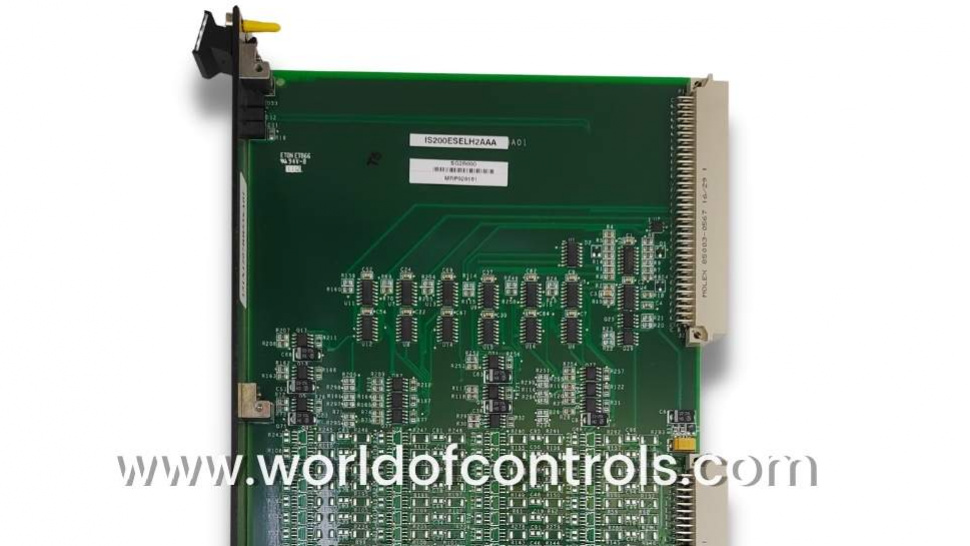

Reliable excitation control is fundamental to the operation of a synchronous generator. The excitation system controls the generator's field and plays an important role in voltage regulation, reactive power control, and overall electrical stability. Within GE EX2100 excitation systems, the Exciter Selector Board provides an important interface between control commands and the power-conversion circuitry responsible for excitation.
The board receives gate-firing commands from the excitation control architecture and routes the appropriate signals toward the exciter gate pulse amplifier boards. In redundant configurations, it also participates in selecting the active controller path, helping ensure that only the designated controller supplies the active firing commands.
For power-generation facilities maintaining GE excitation equipment, understanding this board's function can help with troubleshooting, preventive maintenance, spare-parts planning, and long-term system reliability.
Understanding the Exciter Selector Board
The Exciter Selector Board is part of GE's EX2100 excitation control family. It is installed in the control rack and works with other components in the excitation architecture, including the EMIO and EGPA boards.
Technical documentation describes the board as receiving six logic-level gate-pulse signals from the corresponding master I/O board. These signals are then distributed through multiple cable paths toward the exciter gate pulse amplifier boards located in the power-conversion cabinet.
This makes the board an important signal-routing component.
It does not independently generate the generator's excitation power. Instead, it helps ensure that the correct firing commands reach the downstream power-conversion circuitry responsible for controlling the exciter bridge.
That distinction is important when troubleshooting. A problem involving excitation may originate in the controller, signal interface, selector board, gate pulse amplifier, SCR bridge, or another part of the excitation system.
The Role of Excitation Control in Generator Operation
A generator's excitation system controls the magnetic field associated with the generator rotor. By regulating field excitation, the system can influence generator terminal voltage and reactive power behavior.
In a large power-generation installation, excitation control must operate accurately and respond appropriately to changing electrical conditions.
The excitation architecture can involve:
Control processors
Master I/O interfaces
Exciter selector boards
Gate pulse amplifier boards
SCR power-conversion circuits
Generator field circuitry
Voltage and current feedback
Protection and monitoring functions
Each component has a defined role within the overall system.
The Exciter Selector Board is particularly important because the timing and routing of firing commands ultimately influence the operation of the SCR-based exciter bridge.
How the Exciter Selector Board Processes Gate Signals
Receiving Commands From the EMIO Board
The excitation control system generates gate-firing commands that are delivered to the Exciter Selector Board through the associated EMIO interface.
The board receives six logic-level pulse signals. These signals correspond to the gate-firing requirements of the exciter bridge.
Accurate transmission of these signals is essential because incorrect or missing firing commands can affect the operation of the excitation power-conversion stage.
Selecting the Active Controller
Redundancy is an important feature of many industrial control architectures.
In a redundant EX2100 configuration, two controller paths can be available. Technical descriptions indicate that two ESEL boards can be used, with one associated with the M1 controller and the other with M2. A controller designated C determines which path is active.
This architecture allows the system to maintain an active control path while retaining another controller for redundancy.
Only the selected controller should provide the active gate commands. This prevents conflicting firing commands from reaching the exciter bridge.
Distributing Signals to EGPA Boards
After the appropriate signal path is selected, the gate-pulse commands are distributed toward the EGPA boards.
The EGPA boards are associated with the power-conversion cabinet and provide the interface between the control signals and the SCR firing circuitry. Technical references describe the selector board as distributing the six pulse signals through six cable sets toward the EGPA boards.
This creates a clear signal path:
Control system → EMIO → Exciter Selector → EGPA → SCR bridge
Each stage must function correctly for the excitation system to operate as intended.
Preventing Conflicting Gate Commands
One of the key benefits of the selector architecture is controlled signal selection.
If two redundant controllers were simultaneously allowed to drive the same exciter firing channels, conflicting commands could potentially reach the power-conversion circuitry.
The selector architecture prevents this by ensuring that the active path is selected before gate commands are distributed to the downstream amplifier circuitry.
This is an important reliability feature because the SCR bridge depends on correctly timed firing signals.
Redundancy and Online Repair
Redundancy can improve the availability of industrial excitation systems.
In a redundant configuration, two selector boards can be installed to support separate controller paths. The system can select the active path while retaining another path for backup.
World of Controls describes the two-board configuration as ESEL 1 and ESEL 2, with the active board determined by the system's controller-selection logic.
This architecture can provide an important operational advantage. Depending on the complete system configuration and maintenance procedures, a redundant arrangement can allow certain maintenance activities to be performed without immediately shutting down the entire excitation system.
The exact capabilities depend on the installed EX2100 configuration and applicable GE procedures.
Key Technical Characteristics
The board belongs to GE's EX2100 Excitation Control family and is identified as an Exciter Selector Board.
Important characteristics include:
Product family: EX2100 Excitation Control
Product type: Exciter Selector Board
Function: gate-firing signal selection and distribution
Six gate-pulse signal paths
Three bridge drivers associated with the H2 board group
Interface with EMIO boards
Interface with EGPA boards
Approximate weight: 2 pounds
Technical references identify three bridge drivers on the H2 board group and explain its relationship with the EGPA and EMIO assemblies.
When replacing the board, the complete identification should be verified rather than relying only on the general product description.
Common Causes of Exciter Selector Board Problems
Electronic boards operating in industrial environments can experience several types of degradation.
Component Aging
Long-term operation can affect electronic components through thermal cycling and normal component aging.
As the excitation system accumulates operating hours, maintenance teams may encounter failures associated with aging circuitry.
Electrical Overstress
Power abnormalities, wiring problems, or faults elsewhere in the excitation system can expose electronic components to excessive electrical stress.
A failed selector board should therefore be investigated together with its associated power and signal circuits.
Connector Problems
The selector board relies on physical connections to other system components.
Loose, damaged, contaminated, or incorrectly seated connectors can result in intermittent signal transmission.
Signal Degradation
Because the board handles gate-firing signals, problems in the signal path can affect downstream SCR control.
Signal problems may originate on the selector board, but they can also come from the controller, EMIO board, cabling, or EGPA circuitry.
Excessive Heat
Electronic components are sensitive to excessive temperature. Poor cabinet ventilation, elevated ambient temperatures, or localized heat sources can accelerate component degradation.
Electrostatic Discharge
Printed circuit boards can be damaged by electrostatic discharge during handling.
Appropriate ESD precautions should therefore be used when removing, transporting, storing, or installing the board.
Associated Hardware Failures
An apparent selector-board failure may actually be caused by another component in the excitation chain.
For this reason, maintenance personnel should evaluate the EMIO board, EGPA boards, cabling, power supply, controller status, and associated excitation hardware during troubleshooting.
Signs That the Board Requires Inspection
Several symptoms may justify inspection of the Exciter Selector Board and its associated circuitry.
These can include:
Excitation-system alarms
Generator voltage instability
SCR firing-related faults
Missing or abnormal gate-pulse signals
Intermittent excitation behavior
Controller switchover problems
Signal-interface faults
Visible PCB damage
Damaged connectors
Repeated excitation-related failures
These symptoms should not automatically be attributed to the selector board.
A systematic troubleshooting process should trace the complete signal path from the excitation controller through the EMIO interface, selector board, EGPA circuitry, and SCR bridge.
Maintenance and Troubleshooting Considerations
Maintenance should follow the applicable GE equipment documentation and site electrical-safety procedures.
Before replacing the board, technicians should:
Place the excitation system in the appropriate safe state.
Isolate hazardous electrical energy.
Follow applicable lockout/tagout procedures.
Verify the installed board identification.
Record the hardware revision and configuration.
Inspect connectors and cable interfaces.
Check associated EMIO and EGPA boards.
Verify the controller-selection architecture.
Use appropriate ESD protection.
Perform the required functional checks after installation.
A replacement board should not be installed solely because it has a similar appearance.
Board revision, system configuration, controller architecture, and downstream interfaces should all be considered.
Importance of Spare-Part Availability for Legacy EX2100 Systems
Power-generation facilities often operate critical excitation equipment for many years.
As systems age, replacement boards can become increasingly difficult to source through conventional channels. This is especially relevant for specialized boards that form part of a particular control architecture.
The Exciter Selector Board is a good example because its correct operation depends on its relationship with other EX2100 components.
Maintaining a critical spare can reduce the time required to respond to an unexpected failure.
A spare-parts strategy should consider:
Equipment criticality
Historical failure rates
Component availability
Procurement lead time
Board revision
System configuration
Availability of repair or rebuild services
Planning these requirements before an outage is generally more effective than attempting to source a specialized board after a failure has occurred.
What to Look for in an Exciter Selector Board Supplier
Accurate Part-Number Verification
The supplier should be able to distinguish between different ESEL board groups and revisions.
This is important because boards within the same product family may have different functions or hardware configurations.
Knowledge of GE EX2100 Systems
Experience with GE excitation systems can help suppliers and customers identify the appropriate board and understand its relationship with EMIO and EGPA hardware.
Product Condition Transparency
Customers should know whether a replacement board is unused, rebuilt, refurbished, or previously installed.
This information can be particularly important when sourcing legacy industrial electronics.
Inspection and Testing
Where available, inspection and functional-testing information can help maintenance teams evaluate a replacement component before installation.
International Delivery
When an excitation-system component is required for a critical generator, procurement delays can affect maintenance schedules.
A supplier with established inventory and international shipping capabilities can help reduce these delays.
Why Choose World of Controls?
World of Controls specializes in GE industrial control and turbine-related components and lists the Exciter Selector Board as part of its GE EX2100 product range. Its technical information identifies the board as an EX2100 component used for gate-firing SCRs, with six signal fanouts and three bridge drivers.
For organizations maintaining legacy GE excitation equipment, specialist sourcing can be useful when standard procurement channels cannot easily locate a required board.
When requesting a quotation, customers should provide:
Complete part number
Board revision
Required quantity
Excitation-system model
Controller configuration
Application details
Required delivery timeframe
Providing complete information helps reduce the risk of sourcing an incompatible component.
Best Practices for Excitation-System Spare-Parts Management
A proactive spare-parts strategy can improve maintenance readiness.
Recommended practices include:
Maintain records of installed ESEL boards.
Document hardware revisions.
Record controller and redundancy configurations.
Identify critical excitation components.
Maintain appropriate emergency spares.
Store electronic boards in clean, dry environments.
Use ESD-safe packaging and handling procedures.
Inspect stored components periodically.
Plan procurement before scheduled outages.
Document previous failures and replacements.
Review spare requirements after system modifications.
These measures can help maintenance teams respond more effectively when an excitation-system component requires replacement.
Conclusion
The IS200ESELH2AA - Exciter Selector Board plays an important role in GE EX2100 excitation control systems by selecting and distributing gate-firing commands to the downstream exciter gate pulse amplifier circuitry.
Its role becomes especially important in redundant configurations, where selector boards help manage the active controller path and ensure that conflicting gate commands are not simultaneously supplied to the exciter bridge.
Reliable excitation depends on more than the selector board alone. The EMIO interface, controller architecture, EGPA boards, SCR bridge, cabling, feedback signals, and associated power circuits must all operate correctly.
For facilities maintaining legacy GE excitation systems, accurate identification, preventive maintenance, ESD-safe handling, and dependable spare-parts sourcing can help reduce downtime and support long-term generator reliability.
By incorporating the Exciter Selector Board into a structured maintenance and spare-parts strategy, power-generation facilities can strengthen the availability and reliability of their GE excitation control infrastructure.
Check Also - IS200JPDFG1ACA DC Power Distribution Module (125 V)


Share the News