

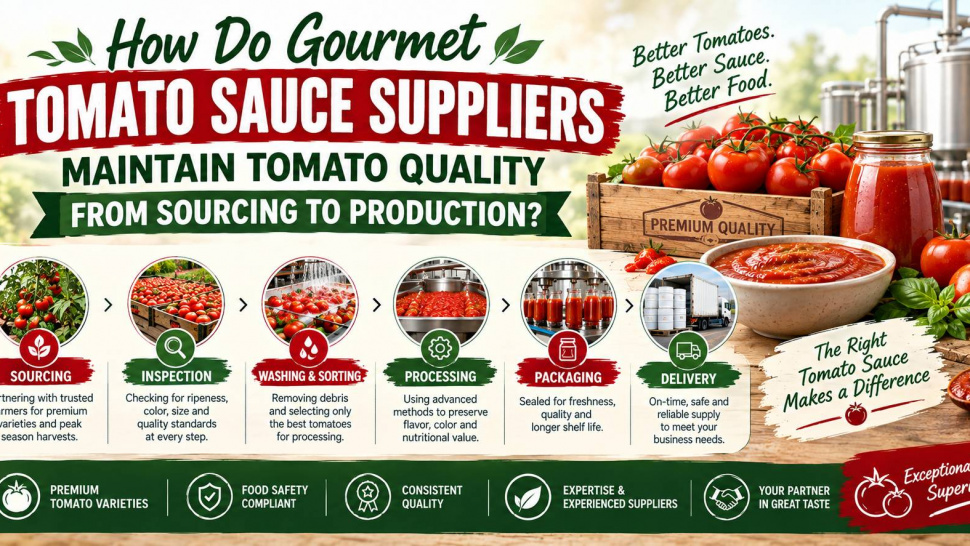

What makes one tomato ingredient reliable in commercial production while another creates trouble halfway through a batch? It is rarely one thing. Flavor counts, but so do color, thickness, concentration, pack size, storage, and behavior under heat. That is why gourmet tomato sauce suppliers have to look beyond the label on a container. Sustainable tomato product suppliers face the same test because poor product matching can create waste, extra handling, and inconsistent finished goods.
Why Does Tomato Quality Begin Before Processing?
Tomato quality starts with the raw material and the intended use. A strong tomato paste may still be wrong for a sauce if its viscosity, acidity, or solids do not fit the recipe.
Experienced gourmet tomato sauce suppliers usually ask what the buyer is making before discussing format. Sustainable tomato product suppliers need that information too because the most practical product is not always the one with the largest pack size or highest concentration.
Pizza sauce may need a thicker base, while soup may need easier flow. Ketchup, salsa, ready meals, and pasta sauces can all use tomato ingredients differently.
Schare & Associates carries tomato paste, diced tomatoes, concentrated crushed tomatoes, whole-pack tomatoes, tomato sauce, and ketchup. That range gives commercial buyers more room to choose by application rather than force one format into every formulation.
How Do Hot-Break And Cold-Break Methods Change The Result?
Processing method changes how tomato paste behaves later. Hot-break processing heats crushed tomatoes quickly and usually gives the paste more body. Cold-break processing tends to produce lower viscosity and a different fresh tomato profile.
That difference affects cooking time, texture, dilution, pumping, and the final feel of a sauce. Gourmet tomato sauce suppliers should explain these differences before a buyer commits to volume. Sustainable tomato product suppliers should also consider the effect of choosing the wrong paste because reworking a batch can increase ingredient use and slow production.
A better review covers concentration, viscosity, acidity, particle size, and heat behavior before purchase approval.
What Should Buyers Check Before A Bulk Order?
A commercial tomato product needs to fit the plant, not just the recipe. Pack size, storage space, batch volume, and usage rate all affect the buying decision.
Before placing an order, buyers should check:
- The tomato format and finished product it will support
- Hot-break or cold-break processing when buyers source paste
- Expected texture, concentration, acidity, and consistency
- Available drums, bins, cans, or packets
- Storage requirements after delivery and opening
- Current order volume and likely future demand
Gourmet tomato sauce suppliers can reduce sourcing problems when they connect these details instead of treating each one separately. Sustainable tomato product suppliers should do the same because a poorly matched pack format can increase waste even when the ingredient itself performs well.
Why Do Packaging And Order Size Deserve More Attention?
Packaging gets less attention than flavor, yet it affects daily production. A large processor may prefer drums or bins because the facility can use that volume quickly. A smaller operation may get better control from cans or packets, especially when several products share one line.
Schare & Associates states that its broader ingredient distribution business can handle purchasing needs from a pail to multiple truckloads. That range can support a product as it moves from trial production into regular manufacturing.
The best pack size depends on actual usage. An oversized container may leave material unused after opening. Too many small containers create extra handling and packaging.
Buyers should review batch size, storage capacity, opening procedures, inventory rotation, and time between production runs. These operational details can have a direct effect on consistency and waste.
How Can Manufacturers Keep Repeat Orders Consistent?
Manufacturers should keep an approved product specification and compare later deliveries against it. A change in thickness, color, acidity, or concentration may force recipe adjustments even when the product name stays the same.
If an item becomes unavailable, the substitute should match the original product’s function as closely as possible. A similar label is not enough.
Buyers should also share changes in forecast volume, packaging preference, or formulation before the next order. That gives the supplier more time to source the correct format instead of rushing into a last-minute substitution.
Conclusion
Wherever commercial tomato sourcing is concerned, the details of purchasing and production teams go hand-in-hand. Gourmet tomato sauce suppliers should be evaluated based on their knowledge of the product, processing capabilities, packaging capabilities, flexibility with orders, and consistency of quality. Just as with other food products, sustainable tomato product suppliers should be held to the same standard, particularly if waste and more efficient use of ingredients are included in the buying brief.
Before approving a long-term supplier, buyers should compare how the tomato product performs in the actual process, not only how it reads on paper. That habit can prevent quality problems that otherwise appear after production has already started.



Share the News