

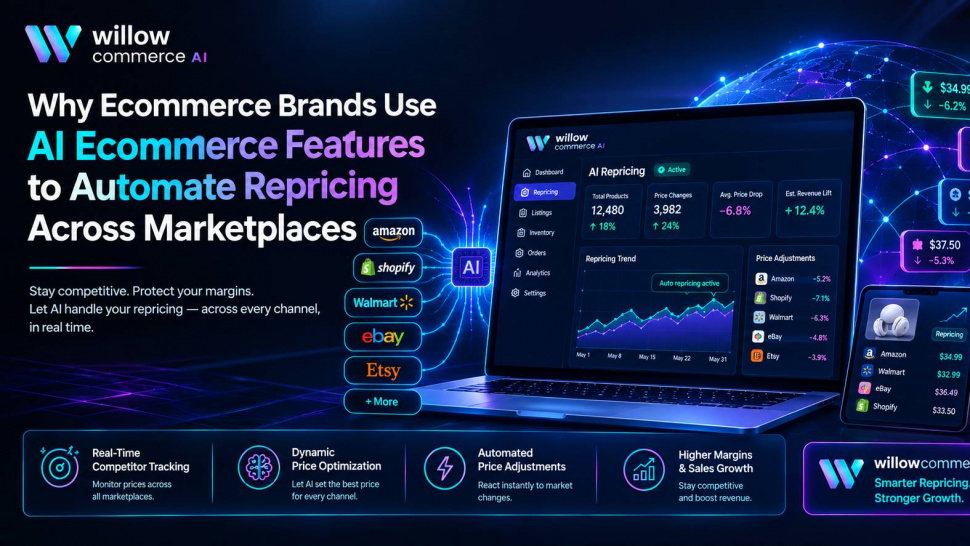

What happens when a seller changes a price on Amazon, but Walmart, eBay, and the brand’s other channels still show something different? It creates a pricing problem that looks small at first, then becomes difficult to control as the catalog grows.
That is why many marketplace sellers now rely on AI e-commerce features for repricing. These systems can react to competitor movement, stock position, channel fees, and margin limits without forcing teams to check every SKU by hand. An AI listing optimization tool can also support the same process because better pricing depends on cleaner product data. For larger catalogs, repricing has become an operations issue, not only a merchandising task.
Why Manual Repricing Becomes Hard To Control
A seller with 50 products can review pricing manually. A seller with thousands of SKUs across several marketplaces cannot do the same thing with any consistency.
Competitors may change prices several times. Inventory may sell faster on one marketplace than another. Fulfillment costs can move. A seller may also have different margin targets for different products. Simple rule-based repricing does not always account for all of that.
For example, a rule that automatically undercuts the cheapest competitor may increase sales for a short period, but it can also damage margins. It may become even worse when the competing seller has a different fulfillment model or is clearing old inventory.
More advanced AI e-commerce features can evaluate several conditions before changing a price. The goal is not constant discounting. The real aim is to make faster pricing decisions within limits the seller has already set.
Willow Commerce approaches repricing as part of a broader operations platform covering inventory, catalog management, orders, warehouses, shipping, analytics, and marketplace automation.
How Catalog Accuracy Influences Repricing Decisions
Repricing software can only work with the information available to it. That sounds obvious, but it causes problems more often than sellers expect. Wrong identifiers, missing product attributes, inconsistent categories, or poorly matched listings can affect competitor comparisons. A repricer may then act on inaccurate information.
An AI listing optimization tool helps improve that foundation. It can organize titles, marketplace keywords, bullet points, descriptions, product attributes, and category information across sales channels. The connection between listings and pricing is important.
A marketplace listing is not just promotional copy. It contains structured product data that platforms use to identify, classify, and compare an item. If that data is inconsistent, automated pricing becomes less dependable.
Cleaner product records also make it easier for teams to manage a catalog when the same SKU appears in several marketplaces with different listing requirements.
How Sellers Use Repricing Without Sacrificing Margin
The lowest price does not always produce the best commercial result. A seller may win more orders at a lower price and still make less money. That is why automated repricing needs clear boundaries.
A useful pricing setup can consider:
- Minimum margin allowed for each SKU
- Current competitor prices
- Available stock by warehouse
- Marketplace fees and fulfillment expense
- Buy Box position
- Recent sales movement
- Slow-moving or excess inventory
- Shipping cost by channel
Once sellers define these limits, AI e-commerce features can handle much of the repetitive monitoring. A high-stock product may support a more aggressive price. A low-stock item may not need a discount at all. Products with expensive fulfillment may require a higher price floor.
This type of logic gives operations teams more control than a basic rule that says, “beat the lowest seller.”
How Automated Repricing Changes Daily Marketplace Work
Most pricing work is not difficult because one individual decision is complex. The difficulty comes from volume.
Teams may need to review hundreds or thousands of small pricing changes. They have to check whether the new price still protects margin, whether inventory can support more demand, and whether a competitor movement deserves a response. Automation changes where people spend their time.
Instead of reviewing every SKU, teams can focus on exceptions. They can investigate products losing margin, listings with unusual price movement, excess stock, or items where marketplace competition has changed. That is a better use of commercial judgment.
An AI listing optimization tool can also reduce repetitive catalog work at the same time, especially where product information needs different formatting for different marketplaces.
Why Pricing Should Connect With Inventory And Fulfillment
Price cannot be separated from the cost of selling the product. A seller may have enough stock overall but very little inventory at the warehouse closest to demand. Shipping costs may rise. A product may suddenly move faster after a promotion. Each situation can change the price a seller is willing to accept.
Connected AI e-commerce features can use those operating conditions as part of pricing decisions instead of treating competitor price as the only signal. This creates a more practical repricing model. It reflects the actual economics behind each order.
Conclusion
Marketplace repricing works better when sellers connect pricing with inventory, fulfillment costs, catalog accuracy, and channel competition. AI e-commerce features can reduce repetitive price monitoring while keeping decisions inside defined commercial limits. An AI listing optimization tool adds another layer of control by improving the product data that pricing systems depend on across multiple marketplaces.



Share the News