

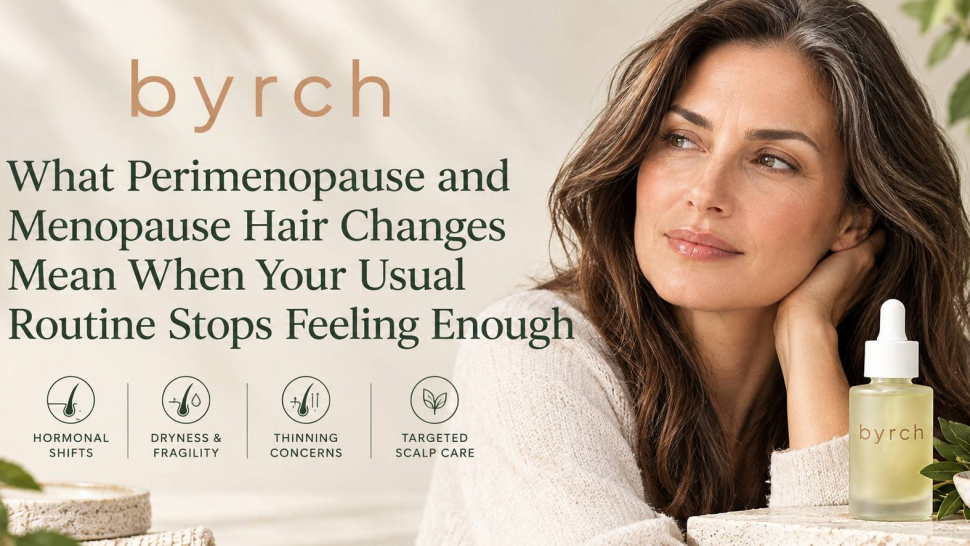

How does the feeling of hair differ if the shampoo, conditioner, and styling products remain unchanged?
The first one may be a ponytail that requires another twist with the elastic. Or dry ends that knot even after you apply a normal conditioner. At times it is not nice on the scalp, and sometimes when the roots are covered with more product, they appear flat.
Knowing the cause of hair changes in perimenopause and menopause helps to replace the products. Less volume, more shedding, and dryness can happen together. That does not mean one product can address all three.
Why the Same Products May Give Different Results
A conditioner may still do its job even when hair no longer looks as full. It coats and conditions the strands; it cannot account for everything happening at the follicle.
Hormonal fluctuations during the menopause transition can affect the hair growth cycle. Some women notice changes in strand thickness or texture. Others notice more shedding.
That leaves an important question: has the hair become harder to manage, or has its density changed?
For perimenopause and menopause hair concerns, the answer affects the next step. Rough lengths call for a review of conditioning and styling habits. A widening part calls for an assessment of hair loss. Neither finding proves that hormones caused the change, since illness, medication, and nutritional deficiencies can contribute.
What to Notice Before Changing the Routine
A few strands in the brush cannot explain what is happening. Short broken pieces may point toward damage, while an increase in full-length strands may suggest shedding. A dermatologist can help distinguish the two and investigate the cause.
Rather than counting every hair, a useful record focuses on changes from the usual pattern:
- The starting point: Note when the change began, including recent illness or changes in medication and diet.
- The affected area: Note if the area looks wider, if the temples are thinner, or if patches have developed.
- Scalp discomfort: This can refer to itching, tenderness, redness, or flaking.
- History of styling: bleach, heat tools, extensions, pulling out roots, etc.
Photos taken under identical lighting and with the same part can be used to compare progress over time. If shedding happens suddenly or bald spots appear, or if the scalp is painful, see your doctor before trying a new cosmetic product.
Why Dry Ends and a Dry Scalp Need Different Care
Applying extra conditioner seems reasonable when hair feels dry. But where it goes changes what it does. Conditioner on the lengths can help with tangles; more product at the roots may add weight without resolving scalp discomfort.
This is where perimenopause and menopause hair care needs a narrower goal. If the concern involves scalp dryness, the product needs to address skin hydration. A promise of volume does not answer that need.
Byrch Beauty describes its Scalp Serum as a lightweight leave-in formula for scalp hydration and fuller-looking hair, with directions for nightly use.
That gives the product a defined cosmetic role. It does not establish that moisturizing the scalp will reverse hair loss. Persistent flaking or itching also needs assessment, since irritation and scalp conditions can resemble dryness.
What “Clinically Studied” Means on a Serum Label
The phrase sounds persuasive, but the next question is straightforward: what did the researchers test?
An ingredient study evaluates a particular preparation, concentration, and application schedule. A finished serum combines ingredients in its own formulation. Evidence for an ingredient does not guarantee that the bottle on the shelf will produce the same results.
Better scalp moisturization does not prove hair regrowth, and a study in one group may not answer questions about menopausal thinning.
Byrch Beauty names Densidyl and Baicapil as its studied active complexes and states that it has not conducted a clinical trial on the finished serum.
For someone comparing perimenopause and menopause hair products, that distinction helps set expectations. Fuller-looking hair describes a cosmetic aim. Treatment of the medical cause of hair loss requires different evidence.
“Hormone-conscious” needs the same scrutiny. A formulation philosophy does not demonstrate that a cosmetic product corrects hormonal changes.
How to Adjust Hair Care Without Losing Track of Results
Replacing every product at once makes the result difficult to interpret. If itching starts, which addition caused it? If hair feels softer, which change deserves credit?
Introducing one product at a time allows a more useful comparison. Following its directions and noting comfort, residue, and manageability keeps the evaluation specific.
Less heat and lower-tension hairstyles can reduce avoidable damage. Conditioner can ease detangling. Those measures support the hair that remains, while a dermatologist investigates noticeable thinning or ongoing shedding.
What a Suitable Routine Can Achieve
Responding to perimenopause and menopause hair changes does not require an expanding collection of products. It requires a closer match between the concern and the response.
Softer lengths, a more comfortable scalp, and improved styling are worthwhile cosmetic goals. Continued loss of density needs a separate assessment. The most suitable routine leaves room for both, without asking a serum to diagnose or treat an unexplained change.



Share the News