

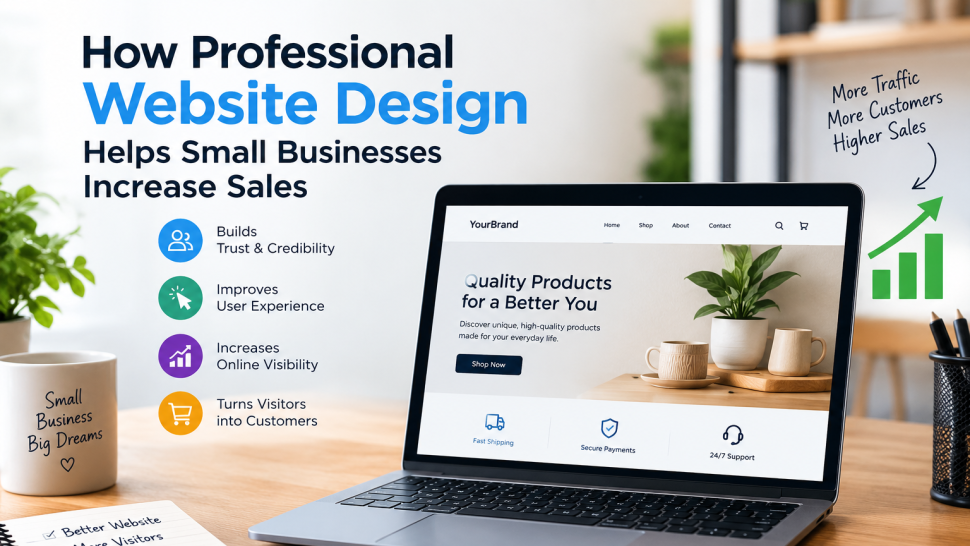

In today's digital world, your website is often the first place potential customers go to learn about your business. Whether you run a local shop, a service-based company, or an online store, your website plays an important role in shaping how people perceive your brand.
A poorly designed website can make visitors leave before they discover what you offer. On the other hand, a professional, user-friendly website can build trust, showcase your products or services, and guide visitors toward making a purchase.
For small businesses, investing in professional website design is not just about creating an attractive online presence. It is about building a digital platform that supports business growth, generates leads, and helps turn visitors into paying customers.
In this article, we will explore how professional website design can help small businesses increase sales and why the right design decisions can make a meaningful difference.
1. Creates a Strong First Impression
First impressions matter, especially when customers are deciding whether to trust a business. When someone visits your website, they quickly form an opinion based on its appearance, layout, and ease of use.
An outdated design, inconsistent colors, poor-quality images, or confusing navigation can make your business appear less credible. Even if you offer excellent products or services, a weak online presentation may discourage potential customers from taking the next step.
Professional website design helps create a polished and consistent brand image. It combines appropriate colors, readable typography, high-quality visuals, and a clear layout to communicate professionalism.
For example, a small consulting firm with a clean website, clear service descriptions, and visible contact information can make it easier for prospective clients to understand its expertise and feel comfortable making an inquiry.
How this helps increase sales: A positive first impression encourages visitors to explore your website, learn about your offerings, and consider doing business with you.
2. Builds Trust and Credibility
Customers are more likely to purchase from businesses they trust. Your website can help establish that trust by presenting your business information clearly and professionally.
A well-designed website should include essential information such as:
A clear About Us page explaining your business and its values.
Detailed product or service descriptions.
Customer testimonials and genuine reviews.
Accurate contact information.
Secure payment options for online purchases.
Clear policies covering returns, refunds, privacy, or service terms where applicable.
These elements help customers understand who you are, what you offer, and what they can expect when working with you.
For e-commerce businesses, a transparent checkout process and visible security indicators can also help customers feel more comfortable completing transactions.
However, trust is built through more than appearance alone. Accurate information, reliable service, genuine customer feedback, and consistent communication are equally important.
How this helps increase sales: When customers feel confident about your business, they may be more willing to contact you, request a quote, or complete a purchase.
3. Improves User Experience and Navigation
A website should make it easy for visitors to find what they need. If users struggle to locate your services, understand your pricing, or find your contact details, they may leave and choose a competitor instead.
Professional website design focuses on creating a smooth user experience by organizing information logically and minimizing unnecessary steps.
Important elements of effective website navigation include:
A simple, clearly organized menu.
Easy-to-find service and product pages.
Descriptive headings and readable content.
Search functionality when a website has many pages or products.
Clear links between related pages.
Accessible forms and straightforward contact options.
Imagine a customer visiting a plumbing company's website because they need an urgent repair. If the phone number, service information, and booking form are easy to find, the customer can quickly take action.
If those details are hidden behind several menus, the customer may give up.
How this helps increase sales: Better navigation reduces friction and makes it easier for visitors to move from researching your business to becoming customers.
4. Makes Your Website Mobile-Friendly
Many people browse websites and research businesses using smartphones. A website that works well on a desktop but poorly on a mobile device can create unnecessary barriers for potential customers.
Mobile-friendly, responsive website design automatically adapts the layout to different screen sizes. Text remains readable, images fit the screen, buttons are easy to tap, and navigation remains usable.
A mobile-friendly website should also avoid common problems such as:
Text that requires users to zoom in.
Buttons placed too close together.
Images that extend beyond the screen.
Pop-ups that block important content.
Forms that are difficult to complete on a phone.
For example, a local fitness studio can benefit from a mobile-friendly website that allows visitors to view class schedules, compare membership options, and register from their phones.
How this helps increase sales: By making your website easier to use on mobile devices, you remove obstacles that could prevent potential customers from contacting you or completing a purchase.
5. Improves Website Speed and Performance
Website speed can significantly affect the user experience. Visitors may become frustrated when pages take too long to load, particularly when they are browsing on mobile devices or using slower internet connections.
Slow performance can also contribute to higher abandonment rates and make it harder for visitors to complete important actions.
Professional website development can address performance problems through techniques such as:
Optimizing images to reduce file sizes.
Reducing unnecessary scripts and plugins.
Using efficient code and appropriate caching.
Choosing reliable hosting.
Improving server response times.
Monitoring real-world page performance.
Website performance should be tested rather than judged by appearance alone. Tools such as Google PageSpeed Insights can help identify technical issues and opportunities for improvement.
It is also important to remember that website speed is only one part of the sales process. Product quality, pricing, customer service, and the overall shopping experience also influence whether visitors make a purchase.
How this helps increase sales: A faster, more responsive website makes browsing and purchasing more convenient, reducing one potential reason for visitors to abandon your site.
6. Uses Clear Calls to Action to Guide Visitors
A call to action (CTA) tells visitors what to do next. Without clear guidance, people may browse your website without knowing how to take the next step.
Effective website design places relevant calls to action where users can easily find them.
Examples include:
Get a Free Quote for service-based businesses.
Book a Consultation for professional services.
Shop Now for e-commerce stores.
Schedule an Appointment for local businesses.
Contact Our Team for general inquiries.
Start Your Free Trial for eligible software products.
The best CTA depends on your business model and the visitor's needs. A person researching a major service may prefer to request more information before making a purchase, while someone who already knows what they want may be ready to buy immediately.
Buttons should use clear language, stand out visually, and lead directly to the relevant page or action.
It is also useful to test different CTA wording, placement, and designs to understand what works best for your audience.
How this helps increase sales: Clear calls to action turn your website from a passive information resource into a practical tool for generating leads and encouraging purchases.
7. Supports Search Engine Optimization (SEO)
Even a beautifully designed website will struggle to generate sales if potential customers cannot find it.
Search engine optimization helps improve a website's visibility in relevant search results. Professional web design and development can support SEO by creating a strong technical and structural foundation.
Important considerations include:
A logical website structure.
Descriptive page titles and meta descriptions.
Clear heading hierarchies.
Search-friendly URLs.
Mobile usability.
Fast-loading pages.
Descriptive image alt text.
Useful, original content that addresses customer questions.
Appropriate internal links between related pages.
For example, a local landscaping company could publish helpful service pages covering garden maintenance, lawn installation, and seasonal landscaping. When these pages answer relevant customer questions and are technically accessible to search engines, they can support the company's organic search visibility.
SEO results are not guaranteed, and professional design alone will not secure higher rankings. Content quality, competition, authority, technical health, and other factors also matter.
How this helps increase sales: Better search visibility can attract people who are actively looking for your products or services, creating more opportunities to generate qualified leads and sales.
8. Showcases Your Products and Services Effectively
Your website should clearly explain what you sell and why customers should choose your business.
Professional design helps present products and services in a way that makes information easy to understand and compare.
For product-based businesses, this may involve:
High-quality product images.
Clear product descriptions.
Accurate pricing and availability.
Useful product categories and filters.
Customer reviews.
Transparent shipping and return information.
For service-based businesses, effective presentation may include:
Dedicated pages for individual services.
Clear explanations of the benefits.
Examples of previous projects.
Relevant case studies.
Service packages or pricing guidance.
Frequently asked questions.
For instance, a digital marketing agency can use dedicated service pages to explain its SEO, web development, and content marketing offerings. This allows potential customers to understand the available solutions and identify which services match their needs.
How this helps increase sales: Clear product and service presentation reduces uncertainty and helps customers make informed purchasing decisions.
9. Makes It Easier to Generate and Capture Leads
Not every website visitor is ready to purchase immediately. Some people need additional information, want to compare providers, or prefer to discuss their requirements first.
A well-designed website gives these visitors convenient ways to connect with your business.
Useful lead-generation features include:
Short contact forms.
Quote request forms.
Appointment booking tools.
Click-to-call phone numbers.
Newsletter sign-up forms.
Downloadable guides or resources.
Live chat or automated support where appropriate.
The key is to request only the information you genuinely need. A form with too many fields can discourage people from completing it.
For example, a home renovation company might ask visitors for their name, email address, project type, and a brief description of their requirements. This provides enough information for an initial conversation without creating unnecessary effort.
Once a lead has been captured, your team can follow up promptly and provide relevant information.
How this helps increase sales: Lead-generation tools help businesses connect with interested prospects who may not be ready to buy during their first visit.
10. Uses Analytics to Improve Sales Performance
A successful website should evolve based on real customer behavior rather than assumptions.
Analytics tools can help small businesses understand how visitors discover their websites, which pages they view, and where they leave the customer journey.
Depending on your setup, you can measure metrics such as:
Website traffic sources.
Landing page engagement.
Contact form submissions.
Quote requests.
Online purchases.
Checkout abandonment.
Conversion rates.
Revenue generated through digital channels.
For example, if an online store receives substantial traffic to a product page but very few purchases, the business could investigate pricing, product information, delivery costs, mobile usability, or checkout friction.
Similarly, if visitors frequently abandon a contact form, simplifying the form or making its purpose clearer may improve completion rates.
Tools such as Google Analytics and Google Search Console can help businesses evaluate website performance and identify potential opportunities.
When collecting visitor data, businesses should also follow applicable privacy requirements and configure tracking appropriately.
How this helps increase sales: Data-driven improvements help you identify problems, prioritize changes, and invest in the website features that contribute most to your business goals.
Common Website Design Mistakes Small Businesses Should Avoid
Even businesses with attractive websites can lose potential customers because of avoidable design and usability problems.
Here are some common mistakes to watch for:
1. Cluttered layouts: Too many competing elements make it difficult for visitors to focus on important information.
2. Unclear messaging: Visitors should quickly understand what your business offers, whom it serves, and what makes it valuable.
3. Missing calls to action: Every important page should give visitors a logical next step.
4. Poor mobile usability: Your website should work comfortably across smartphones, tablets, and desktop computers.
5. Slow loading pages: Large images, unnecessary scripts, and inefficient hosting can hurt performance.
6. Outdated information: Incorrect prices, old contact details, and discontinued services can damage customer confidence.
7. Ignoring accessibility: Poor color contrast, missing form labels, and inaccessible navigation can prevent people from using your website effectively.
8. Failing to measure results: Without appropriate tracking, it becomes harder to determine which pages and features are helping your business grow.
Addressing these problems can improve usability and create a better foundation for lead generation and sales.
How Much Should a Small Business Invest in Professional Website Design?
The cost of professional website design varies depending on the project's complexity, required functionality, content needs, and development approach.
A simple informational website will generally require a different budget from a custom e-commerce platform with payment integration, inventory management, customer accounts, and advanced features.
Before setting a budget, consider the following factors:
Business goals: Are you trying to generate leads, sell products, accept bookings, or establish brand credibility?
Website size: How many pages and service categories do you need?
Required functionality: Will you need e-commerce, appointment scheduling, customer portals, or third-party integrations?
Content requirements: Do you need professional copywriting, photography, or original graphics?
Ongoing maintenance: What will you need for security updates, hosting, backups, and technical support?
Future growth: Can the website accommodate new services, products, or markets?
Rather than choosing a provider based solely on the lowest initial price, evaluate the quality of the work, the scope of services, communication, maintenance options, and the provider's understanding of your business objectives.
A website should be viewed as a business investment, but higher spending does not automatically guarantee better sales. The right solution is one that meets your needs, fits your budget, and supports measurable business goals.
How to Measure Whether Your Website Is Increasing Sales
After launching or redesigning your website, establish a baseline so you can evaluate its performance over time.
Start by identifying the actions that matter most to your business.
For a service-based company, these might include qualified inquiries, quote requests, and booked consultations. For an online store, they might include completed purchases, average order value, and revenue.
A basic conversion rate can be calculated using this formula:
Conversion rate = (Number of conversions ÷ Number of visitors) × 100
For example, if a website receives 1,000 visitors and generates 30 completed purchases during the same measurement period, its visitor-to-purchase conversion rate is 3%.
This is an illustrative example, not a universal benchmark. Actual performance varies by industry, audience, traffic source, and the way conversions are measured.
To make your analysis more useful:
Record your current website traffic and conversion metrics.
Identify the pages where visitors frequently leave.
Review mobile performance and loading speed.
Test improvements to key landing pages and calls to action.
Compare results over a meaningful period.
Focus on qualified leads and profitable sales rather than traffic alone.
Remember that a website redesign may improve some metrics without immediately increasing revenue. Results also depend on marketing, pricing, competition, product quality, and the effectiveness of your sales process.
Conclusion
Professional website design can help small businesses create a stronger first impression, establish credibility, improve navigation, attract relevant traffic, and make it easier for customers to take action.
From mobile responsiveness and website speed to clear calls to action and effective lead-generation tools, every design decision should contribute to a better customer experience and support a defined business objective.
However, a successful website requires more than attractive visuals. It combines thoughtful design, reliable development, useful content, search engine optimization, and ongoing performance improvements.
If your current website is outdated, difficult to navigate, or failing to generate the results you expect, it may be time to reassess your digital strategy.
The Creative Unit can help your business build a professional online presence that aligns with your goals and creates a better experience for your customers. Explore your website design and development options at The Creative Unit and take the next step toward building a website that supports your business growth.
Frequently Asked Questions (FAQs)
1. Why is professional website design important for small businesses?
Professional website design helps small businesses present a credible brand image, communicate their offerings clearly, improve usability, and make it easier for customers to contact the business or complete purchases.
2. Can a well-designed website increase sales?
Yes, a well-designed website can support higher sales by improving the customer journey, reducing friction, presenting products effectively, and encouraging visitors to take action. However, results depend on factors such as demand, pricing, traffic quality, and the overall customer experience.
3. How often should a small business redesign its website?
There is no fixed redesign schedule. Businesses should review their websites regularly and consider a redesign when the site no longer meets customer needs, has significant technical limitations, looks outdated, or fails to support current business objectives.
4. Does website design affect SEO?
Yes. Website structure, mobile usability, page speed, accessibility, and the organization of content can influence how easily users and search engines access and understand a website. However, good design alone does not guarantee higher search rankings.
5. What features should every small business website include?
Most small business websites benefit from clear service or product information, an About Us page, contact details, mobile-friendly layouts, prominent calls to action, secure connections, and useful content. Additional features depend on the business model.
6. Is a mobile-friendly website necessary for small businesses?
Yes. Mobile-friendly design makes it easier for visitors to browse information, contact your business, and complete transactions on smartphones and tablets. It also supports a better overall user experience.
7. How can I tell if my website needs improvement?
Warning signs include declining leads, low engagement on important pages, slow loading times, difficult mobile navigation, outdated information, and high abandonment during important conversion steps. Analytics and usability testing can help identify the underlying issues.
8. Should I hire a professional web design agency or build my own website?
A DIY website can be suitable for a simple project with a limited budget and straightforward requirements. A professional agency may be a better fit when you need custom functionality, a distinctive brand experience, technical expertise, integrations, or a website designed around specific business goals.



Share the News