

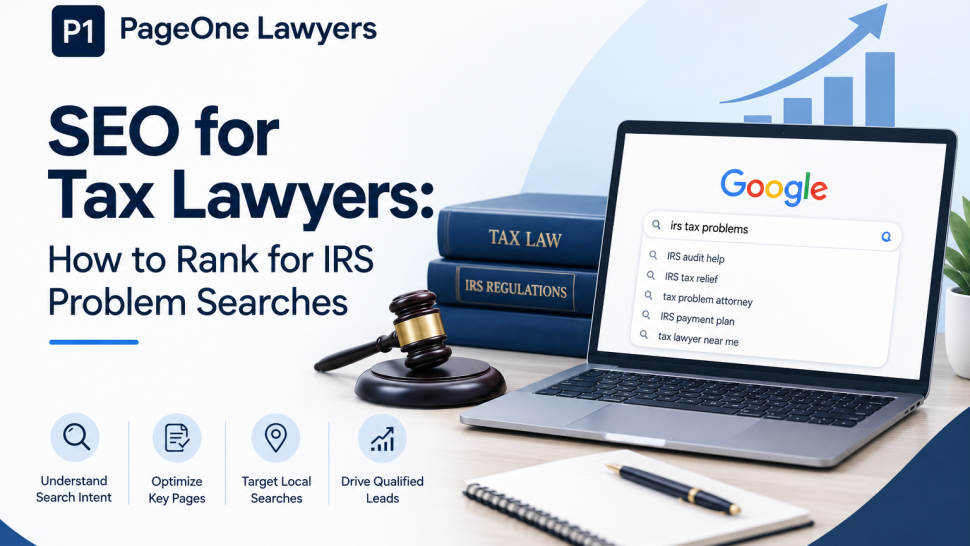

Nobody searches “tax attorney” when life is calm. They search when a letter arrives from the IRS, when a bank account gets levied, or when an audit notice lands in the mailbox. The searches are urgent, personal, and often expensive for the person making them.
That urgency is the opportunity. A tax controversy client typically has a large problem and a clear willingness to pay for help. The firm that appears first, with a page that speaks directly to their situation, usually gets the call.
This guide covers SEO for tax lawyers with a focus on IRS problem searches: what people type, how to build pages that answer them, and how to turn rankings into signed engagements.
What Is SEO for Tax Lawyers?
SEO for tax lawyers is the process of improving a tax law firm’s website so it ranks on Google for searches made by individuals and businesses facing tax problems, such as IRS audits, back taxes, wage garnishments, and penalty disputes. The goal is qualified consultations, not just visitors.
It involves practice area pages, local visibility, helpful content, credible links, and a site that’s fast and easy to contact. Specialist providers like PageOne Lawyers focus on exactly this kind of legal marketing, but the principles are straightforward enough for any firm to apply.
Why IRS Problem Searches Are Different
Most legal searches are about finding a lawyer. IRS problem searches start one step earlier. People describe their trouble first and look for a lawyer second.
Typical examples:
“I received an IRS audit letter, what do I do”
“IRS wage garnishment help”
“owe back taxes can’t pay”
“IRS penalty abatement lawyer”
“unfiled tax returns attorney”
These searchers are anxious. They want reassurance and a clear next step. Pages that open with a calm explanation of the problem, then explain how a tax attorney helps, tend to outperform generic “Our Tax Services” pages.
1. Build One Page Per IRS Problem
This is the single biggest improvement most firms can make. A page titled “Tax Law” that lists ten services in a paragraph each won’t beat a page dedicated to IRS audit defense.
Create focused pages for your core services:
IRS audit representation
Back tax and payment plan help
Wage garnishment and bank levy release
Penalty abatement
Unfiled returns
Offer in compromise
Each page should explain the problem in plain language, outline your process, address common fears, and end with an obvious way to contact you. For a view of how a service page can be organized around search intent, see how PageOne Lawyers approaches tax law SEO.
2. Choose Keywords by Intent, Not Just Volume
Smaller phrases often convert better than big ones. A firm chasing the broadest tax phrase competes with national publishers. A firm targeting “IRS wage garnishment attorney” in its own city competes with far fewer.
It also helps to understand the two audiences around this topic:
Injured-by-the-IRS searchers: individuals and business owners with a tax problem.
Firm-owner searchers: partners researching tax law SEO, tax lawyer SEO, or a tax attorneys SEO agency.
If you’re a firm owner reading this, you’re the second group. If you write for firms, those are the phrases decision-makers use. Map each keyword to one page so your own pages don’t compete with each other.
3. Write Content That Answers the Frightened Question
People facing the IRS ask very direct questions. Can the IRS take my paycheck? What happens if I ignore the letter? Do I need a lawyer or just an accountant?
Answer them honestly. A short, clear article on a single question tends to build trust quickly, and it gives Google more ways to connect your site to what people search.
Strong topics for a tax law blog:
What an IRS CP2000 notice actually means
What to do in the first week after an audit letter
Tax attorney vs. CPA vs. enrolled agent: who handles what
How installment agreements work and who qualifies
Warning signs that an IRS issue needs a lawyer
Keep claims accurate and current. Tax rules change, so review published content regularly and date it. Outdated legal content hurts credibility with readers and search engines alike.
4. Strengthen Tax Law Firm SEO With Local Signals
Even though tax law can be handled remotely, many clients still want a firm they can meet. Local signals matter, especially for individual clients.
Start with your Google Business Profile. Keep your name, address, and phone number identical everywhere online. Choose accurate categories, add real photos, and reply to every review. Then create location pages for cities you genuinely serve, each with original content rather than copied text with a new city name.
For firms that serve clients across many states, build pages by state and explain any licensing or jurisdiction details clearly. That honesty is both a trust signal and a filter that saves time on unqualified calls.
5. Show Expertise: The E-E-A-T Factor
Google holds legal and financial content to a higher standard because mistakes can hurt people. That means your site must show who is behind the advice.
Make this visible:
Attorney bios with credentials, bar admissions, and tax-specific experience
Mentions of relevant background, such as former IRS or Treasury work, where true
Clear authorship and review dates on articles
Real client reviews and, where your state’s rules allow, representative outcomes
A tax attorney bio that says “experienced in all areas of law” says very little. One that explains the types of IRS disputes you resolve says a lot.
6. Make the Site Fast, Clear, and Easy to Contact
A worried person won’t hunt for your phone number. Check the basics:
Pages load quickly on mobile
The phone number is clickable and visible in the header
Contact forms are short
Pages use clear headings and short paragraphs
Add a confidential consultation message near your contact options. People dealing with tax trouble often fear judgment or exposure. Reassurance about privacy lowers the barrier to reaching out.
7. Earn Credible Links and Mentions
Links from trusted websites signal authority. For tax firms, good sources include legal directories, local business groups, bar associations, accounting and finance publications, and guest posts on relevant industry sites.
Choose quality over volume. A single link from a respected publication usually beats dozens from low-quality directories. Be careful with any vendor that promises hundreds of links quickly, since that approach can lead to penalties.
Expert Insight: Why Most Tax Firm Sites Underperform
In our experience reviewing law firm sites, the most common weakness isn’t technical. It’s that the website describes the firm instead of the client’s problem. Visitors don’t want to read about your history first. They want to know whether you can help with their notice, their levy, or their audit. Flip the structure, lead with the problem, and conversion tends to improve.
Common Mistakes to Avoid
One generic “Tax Law” page. It can’t rank for specific problems.
Giving state-specific advice without naming the state. It’s inaccurate and risky.
Ignoring reviews. They influence rankings and decisions.
Publishing and forgetting. Tax content ages quickly.
Skipping call tracking. Without it, you can’t see which pages produce clients.
Choosing an SEO Partner for Your Tax Firm
Some firms handle SEO in-house. Many hire a specialist, and the choice often comes down to time and expertise. If you’re comparing a tax attorneys SEO agency or a tax law SEO company, ask a few direct questions:
Do you have experience with legal marketing and its advertising rules?
Will content be written or reviewed by people who understand tax law?
How do you report results: rankings only, or calls and signed cases?
Who owns the content and accounts if we part ways?
Larger practices with multiple offices or states have additional needs. Enterprise SEO for tax law firms involves managing many location pages, consistent branding, and technical structure at scale, so it’s worth asking whether a provider has handled that complexity before.
How PageOne Lawyers Can Help
PageOne Lawyers works with law firms that want predictable growth from search. For tax practices, that means problem-focused service pages, local and state visibility, authority-building links, and conversion improvements that turn visitors into consultations.
If your firm relies mostly on referrals and you want a steadier flow of tax clients, SEO for tax lawyers is worth a serious look. You can explore the tax law SEO service here or visit PageOne Lawyers to request a strategy call.
Ranking for IRS problem searches comes down to a handful of disciplined steps: one page per problem, keywords chosen by intent, honest content, local and state signals, visible expertise, a fast and reassuring site, and credible links. Do these consistently, and the calls follow.
FAQs
Q1. How do tax attorneys rank for IRS problem searches?
Ans - By creating dedicated pages for each IRS issue, such as audits, levies, and back taxes, writing clear content that answers the searcher’s urgent questions, showing attorney credentials, and building local and authority signals.
Q2. How long does SEO for tax lawyers take to work?
Ans - Early movement often appears in three to six months, with stronger results afterward. Timing depends on competition, your site’s starting point, and how consistently you publish and improve content.
Q3. Is tax law SEO worth it compared to paid ads?
Ans - Paid ads bring faster leads but stop when spending stops. SEO builds an asset you own and tends to lower your cost per client over time. Many firms use both.
Q4. What should I look for in a tax attorneys SEO agency?
Ans - Look for legal industry experience, content reviewed by people who understand tax law, transparent reporting tied to calls and cases, and clear ownership of your site and content.
Q5. Can a small tax firm compete with larger firms online?
Ans - Yes. Specific problem pages, local focus, and strong reviews let smaller firms outrank bigger ones for the searches that matter most.



Share the News