

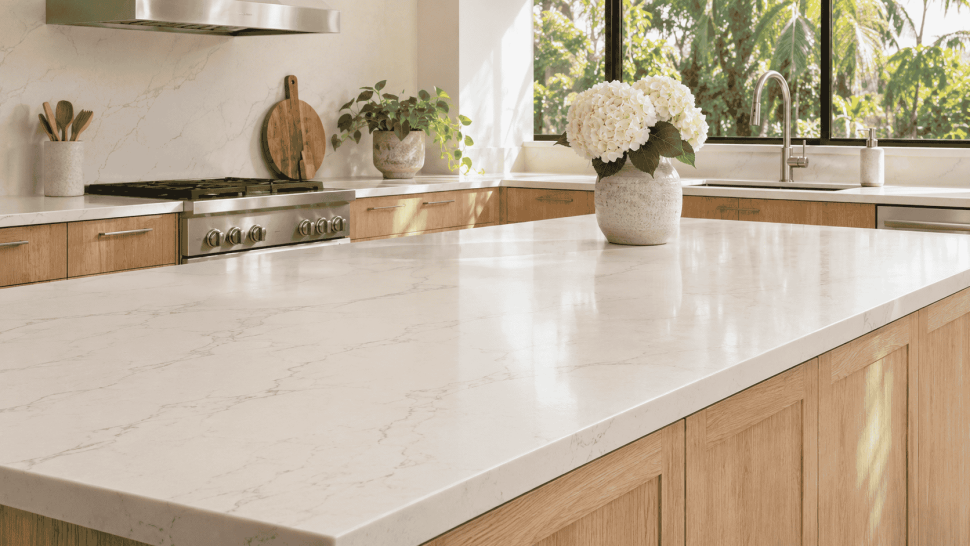

The edge of a countertop is easy to overlook when you’re looking at a full slab. At home, it’s where you rest your hands while talking across the island, where a cabinet drawer opens beneath the counter, and where a heavy pan might bump the rim of the sink. If you’re choosing quartz countertops for a Tampa Bay kitchen, spend a few minutes with actual edge samples. The profile you like in a photo may feel quite different where you stand and work every day.
## Learn the Basic Shapes Before You Compare Names
Showrooms may use different names for similar profiles. Ask to see a finished sample of the edge offered in your quote, especially if someone describes it as *standard* or *square*. A straight-looking edge can still have a softened corner, and two edges labeled *eased* may look different when you put them side by side.
| Edge profile | What to look for on the sample |
|---|---|
| Eased | A mostly straight front with a slightly softened corner. |
| Bullnose | A rounded front. Ask whether the rounding continues around the underside. |
| Beveled | An angled face that creates a visible break along the edge. |
| Ogee | A decorative profile with an S-shaped curve. |
| Mitered | Two joined pieces that can give the countertop a thicker-looking front. |
Cambria’s edge guide illustrates several of these profiles and explains how a mitered edge creates a thicker appearance. Treat the names as a starting point. The sample and drawing tell you what the fabricator actually plans to make.
## See the Edge From the Place You’ll Use It
Hold a sample at roughly the height of your finished countertop. Look down at it as you would while chopping vegetables, then sit at the island or dining table and look across at the front. A decorative curve that barely registers from above may be one of the first details you see from a chair.
Then rest your hand on the sample. Does the front feel comfortable where you’d lean while eating breakfast or talking to someone in the kitchen? If you like a simple profile, compare two samples with slightly different rounding. You may prefer the look of one and the feel of the other. It’s an easier choice to make before the profile has been cut into a long stretch of counter.
## Pay Attention to Corners Along Walking Routes
An edge profile describes the shape you see from the side. The shape of the island corner you walk past is a separate detail. You can have a softened front edge and still have an island that comes to a tight corner when viewed from above.
Walk through your current kitchen and notice where you tend to brush past the counter. Maybe the corner nearest the refrigerator sits right where you turn with a grocery bag. If the proposed countertop extends farther than the old one, mark the outline on the floor and walk the route again. Show the fabricator any spot that feels awkward. Ask to see how the corners would be drawn and how that shape would look with the edge profile you’ve chosen.
## Discuss the Sink Edge Separately
If you’re planning an undermount sink, ask the fabricator to show you how the exposed quartz around the opening will be finished. It’s a different location from the front of the island, and you’ll use it differently. A heavy pot lifted out of the sink can meet that edge at an angle you wouldn’t expect when looking at a sample in a showroom.
Caesarstone’s design guidance notes that a larger edge radius can improve resistance to chipping on its surfaces. Ask what the manufacturer recommends for your material and what the fabricator can do around your sink. Bring the sink model information so the conversation is based on the fixture you’ll install. You can prefer a particular look for the island and still make a separate decision about the edge around the basin.
## Check the Details of a Thick-Looking Edge
A mitered front can give an island a more substantial appearance. Before you decide, have the fabricator show you where the top and front pieces join. If your quartz has pronounced veins, look at how the pattern would meet at that joint and continue around any corners. A narrow sample might show the shape clearly without showing what a vein will look like across the full front.
Check the drawing against what sits beneath the counter. Point out the upper drawers, cabinet doors, dishwasher, and seating area. Ask how the proposed edge will sit relative to those features. A thicker appearance may look right at home on an island but feel too prominent above a short run of cabinets. If you’re considering it only for one part of the kitchen, review how it will look beside the simpler edges elsewhere.
## Compare Decorative Profiles With the Cabinets in View
A profile with several curves can look good beside cabinet doors that already have some detail. If the doors have plain fronts and simple hardware, you may prefer an edge that draws less attention. Try the sample next to the cabinet door instead of judging it on its own. Look at the shadows the profile creates under the lighting you normally use.
You can also think about how you wipe the counter after cooking. Run a cloth over the sample the way you’d clean the front edge. If the profile has a recess, see whether your usual motion reaches it. A small difference in cleanup may be worth it for an edge you really like. It’s better to decide that with the sample in hand than to discover it the first time you wipe down the kitchen.
## Write Down the Profile for Each Area
Before approving fabrication, confirm the edge on the island, the perimeter, and any exposed ends. Check how the corners and sink opening are shown. If the quote uses a showroom name, save a photo of the actual sample so you and the fabricator have the same reference. Ask whether the selected profile changes the quote and whether it’s available with the slab and finish you picked.
Then take one last look at the places you’ll see and touch most. If the edge feels right at the breakfast seats, fits the route past the refrigerator, and looks good against the cabinet doors, you’ve made a choice that holds up outside the showroom.



Share the News