

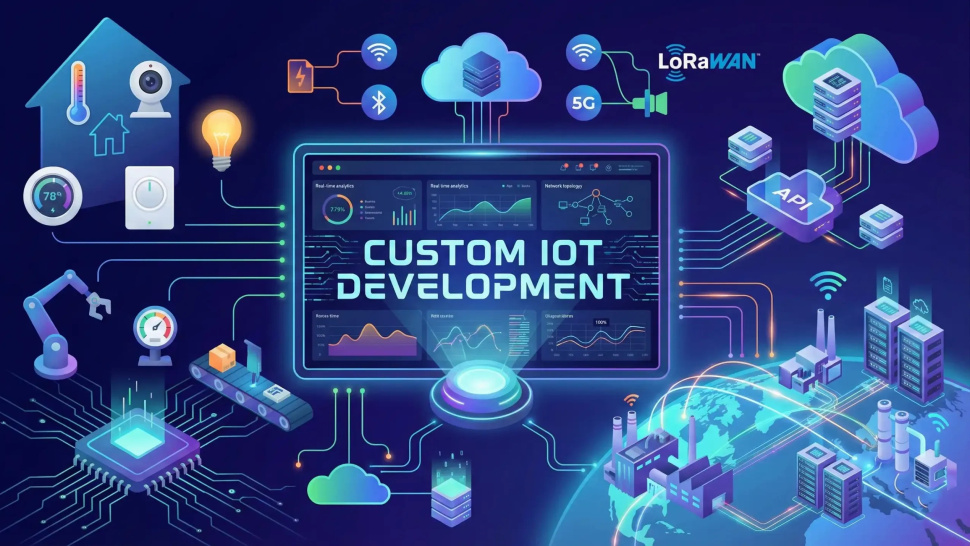
Off-the-shelf IoT products work well for simple jobs. A smart plug, a basic GPS tracker, or a standard temperature logger can be up and running in an afternoon.
Problems start when your needs don’t fit the box. Your machines use older protocols. Your sites have poor connectivity. Your data has to flow into systems that standard tools don’t support. Or the connected product is the thing you sell, and it needs to feel like yours.
That is where custom IoT solutions come in. They give you control over hardware, software, data, and user experience, but they also bring more decisions and more ways to go wrong. This article covers the key considerations before you commit budget.
When Custom Makes Sense
Not every project needs a custom build. A ready-made platform is often the smarter, cheaper choice. Custom development tends to pay off when:
- Your workflow or hardware is unusual
- You need deep integration with proprietary systems
- Security or compliance rules limit what you can use
- You plan to scale to thousands of devices, where per-device licensing adds up
- The connected product is part of your brand and customer experience
If none of these apply, start with an existing platform and revisit later.
Key Considerations
1. Define the Business Problem First
Technology should follow the goal, not lead it. Write down what needs to improve and attach a number to it:
- Reduce unplanned downtime on one production line by a set percentage
- Cut spoilage on a specific shipping route
- Lower energy use across a group of buildings
- Shorten response times for field service
Rolls-Royce is a useful reference. It monitors engine data in flight so maintenance can be planned around real condition. The technology serves a clear commercial aim: more uptime for customers.
2. Choose Hardware That Fits the Real Environment
A sensor that works on a desk may fail on a factory floor. Consider:
- Conditions: heat, dust, moisture, vibration
- Power: battery life matters when devices are hard to reach
- Accuracy: how precise must readings be?
- Cost at scale: a small saving per unit multiplies across thousands of devices
- Off-the-shelf or custom hardware: custom boards give control but add time and cost
Test a small batch in real conditions before placing a large order.
3. Match Connectivity to the Site
There is no best network, only the best fit.
- Wi-Fi: indoor, high bandwidth, power available
- Cellular (LTE, 5G, LTE-M, NB-IoT): wide coverage and mobility
- LoRaWAN: long range, low power, small data packets
- Bluetooth: short range, low energy
Check coverage at your actual sites. Plan for outages too: devices should store data locally and sync when the connection returns.
4. Decide What Happens at the Edge
Not every decision should wait for the cloud. Shutting down an overheating machine should happen locally and instantly. Long-term storage and heavy analysis fit the cloud. Most real systems use both, and deciding the split early affects hardware, cost, and reliability.
5. Build Security In From Day One
Every connected device is a possible entry point. In 2016, the Mirai botnet took over hundreds of thousands of devices, mostly because of default passwords. In 2015, researchers remotely took control of a Jeep Cherokee, leading Chrysler to recall about 1.4 million vehicles for a software fix.
Cover these basics:
- Unique credentials for every device
- Encryption in transit and at rest
- Secure boot and signed firmware
- Network segmentation
- Access controls and audit logs
- A tested over-the-air (OTA) update process
Security added after launch is expensive and incomplete.
6. Plan the Team and Skills
IoT crosses firmware, hardware, networking, cloud, data, and application development. Few internal teams cover all of it. Decide early which skills you have and which you need to hire or bring in.
Many businesses work with an experienced IoT software development company for architecture and development while keeping product decisions in-house. When you evaluate one, look for experience across the whole chain, a clear security approach, honest advice on scope, and support after launch.
7. Design for Data, Not Just Devices
Sensors produce a constant stream of readings, and much of it is noise. Decide in advance:
- What you need to measure, and how often
- How long you store it
- How you validate and clean it
- Who can see it
- Which alerts actually trigger action
Too many alerts teach people to ignore them. Start with a few tied to real decisions.
8. Integrate With Your Business Systems
IoT data only creates value when it reaches the people and systems that act on it. A temperature alert in a dashboard nobody checks is a more expensive thermometer. Map how data will flow into your ERP, CRM, maintenance, and analytics tools. Legacy systems often lack modern APIs, which makes integration one of the most underestimated parts of the budget.
9. Plan for Scale and Device Lifecycle
A pilot with 50 devices can behave very differently at 50,000. Consider provisioning, device monitoring, message volumes, and cloud costs as the fleet grows.
Also plan for the end of a device’s life. Batteries die, firmware ages, and hardware gets replaced. Tesla’s ability to update vehicles over the air shows what a strong update strategy can do, but it needs safeguards such as staged rollouts and rollback options.
10. Check Compliance and Privacy
IoT can collect location, health, or usage data. Depending on your industry and region, that brings GDPR, HIPAA, or sector-specific rules into play. Involve legal and compliance teams during design, not at launch.
What Custom IoT Solutions Cost
Costs vary widely, so treat any single figure with caution. The main areas are:
- Hardware, gateways, and prototypes
- Connectivity and data plans
- Firmware, cloud, and application development
- Integration with existing systems
- Security testing and compliance
- Installation and training
- Ongoing hosting, device management, and support
Teams often budget carefully for hardware and underestimate software and maintenance. Over a product’s life, those frequently cost more than the devices. A focused pilot usually costs a fraction of a full rollout and exposes surprises early.
Common Risks
- Unclear goals: projects drift without a measurable target
- Security gaps: weak authentication and unpatched firmware
- Poor connectivity planning: devices drop offline in real conditions
- Integration delays: legacy systems slow the rollout
- Vendor lock-in: proprietary platforms limit future options
- Scope creep: every new sensor adds cost and complexity
A Practical Development Path
- Define the goal and success metrics.
- Audit existing equipment and data.
- Design the architecture: devices, connectivity, edge versus cloud, security.
- Prototype and test hardware in real conditions.
- Build a focused pilot with a fixed scope and timeline.
- Integrate with daily tools so data drives action.
- Measure results against your baseline.
- Scale in stages, with monitoring and support in place.
Best Practices
- Tie every sensor to a decision. If nobody will act on the data, skip it.
- Prefer open standards to reduce vendor lock-in.
- Treat security as ongoing work, not a launch checklist.
- Test in real conditions, including poor networks and extreme temperatures.
- Involve end users early. Technicians and operators spot weak designs fast.
- Design for updates from the start.
- Track business results, such as downtime avoided or cost saved, not just device uptime.
Adding Intelligence Later
Once reliable data is flowing, many companies add predictive models, anomaly detection, or computer vision on top. This works best when the data foundation is clean. If AI is on your roadmap, the right AI software development services can help you build on those foundations, and Bitrupt works across IoT, AI, cloud, and custom software, which helps when a project crosses several of these areas.
Conclusion
Successful custom IoT solutions start with a clear business problem, a realistic view of the full stack, and early decisions about security, integration, and scale.
Start small, measure honestly, and expand once the results justify it. That approach protects your budget and gives your team data they will actually use.
Frequently Asked Questions
1. What are custom IoT solutions?
They are connected systems built around your specific needs, including devices, firmware, connectivity, cloud platform, and applications, instead of using a generic ready-made product.
2. How long does it take to develop a custom IoT solution?
A focused pilot can take a few months. Full deployments take longer, especially with custom hardware, multiple sites, or complex integrations.
3. How much do custom IoT solutions cost?
It depends on device count, hardware design, connectivity, software, integration, and compliance. Ask for a breakdown that includes software and long-term support, not just hardware.
4. What is the biggest risk in IoT development?
Security gaps and unclear goals are the most common. Underestimating integration and maintenance also causes many overruns.
5. Should I build IoT in-house or hire a partner?
If your team lacks experience across hardware, cloud, security, and applications, a partner can reduce risk. Many companies use a hybrid approach, keeping product decisions in-house and bringing in specialists for architecture and development.



Share the News