



Nanorobotics is the technology of creating machines or robots at or close to the scale of a nanometre (10-9 metres).
More specifically, nanorobotics refers to the still largely theoretical nanotechnology engineering discipline of designing and building nanorobots.
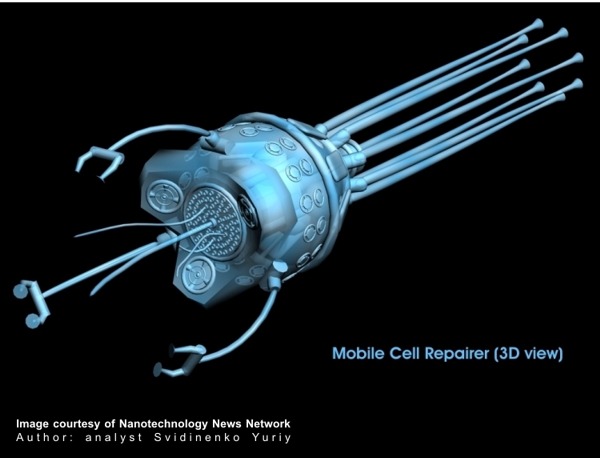
Nanorobots (nanobots or nanoids) are typically devices ranging in size from 0.1-10 micrometres and constructed of nanoscale or molecular components.
As no artificial non-biological nanorobots have so far been created, they remain a hypothetical concept at this time.
Another definition sometimes used is a robot which allows precision interactions with nanoscale objects, or can manipulate with nanoscale resolution.
Following this definition even a large apparatus such as an atomic force microscope can be considered a nanorobotic instrument when configured to perform nanomanipulation.
Also, macroscale robots or microrobots which can move with nanoscale precision can also be considered nanorobots.
http://en.wikipedia.org/wiki/Nanorobotics
Nanomedicine is the medical application of nanotechnology and related research.
It covers areas such as nanoparticle drug delivery and possible future applications of molecular nanotechnology (MNT) and nanovaccinology.
Nanoparticle
A nanoparticle (or nanopowder or nanocluster or nanocrystal) is a microscopic particle with at least one dimension less than 100 nm.
Nanoparticle research is currently an area of intense scientific research, due to a wide variety of potential applications in biomedical, optical, and electronic fields. Nanoparticles are of great scientific interest as they are effectively a bridge between bulk materials and atomic or molecular structures.
A bulk material should have constant physical properties regardless of its size, but at the nano-scale this is often not the case.
Size-dependent properties are observed such as quantum confinement in semiconductor particles, surface plasmon resonance in some metal particles and superparamagnetism in magnetic materials. The properties of materials change as their size approaches the nanoscale and as the percentage of atoms at the surface of a material becomes significant.
For bulk materials larger than one micrometre the percentage of atoms at the surface is minuscule relative to the total number of atoms of the material.
The interesting and sometimes unexpected properties of nanoparticles are not partly due to the aspects of the surface of the material dominating the properties in lieu of the bulk properties. Nanoparticles exhibit a number of special properties relative to bulk material.
For example, the bending of bulk copper (wire, ribbon, etc.) occurs with movement of copper atoms/clusters at about the 50 nm scale.
Copper nanoparticles smaller than 50 nm are considered super hard materials that do not exhibit the same malleability and ductility as bulk copper.
The change in properties is not always desirable.
Ferroelectric materials smaller than 10 nm can switch their magnetisation direction using room temperature thermal energy, thus making them useless for memory storage.
Suspensions of nanoparticles are possible because the interaction of the particle surface with the solvent is strong enough to overcome differences in density, which usually result in a material either sinking or floating in a liquid.
Nanoparticles often have unexpected visible properties because they are small enough to confine their electrons and produce quantum effects.
For example gold nanoparticles appear deep red to black in solution. Nanoparticles have a very high surface area to volume ratio.
This provides a tremendous driving force for diffusion, especially at elevated temperatures.
Sintering can take place at lower temperatures, over shorter time scales than for larger particles.
This theoretically does not affect the density of the final product, though flow difficulties and the tendency of nanoparticles to agglomerate complicates matters.
The large surface area to volume ratio also reduces the incipient melting temperature of nanoparticles.
Share the News