



First Fairtrade products have been hand woven clothing or decorative items and decorative handicraft works. Over time, the list of products grew, but the market's success was lacking.For decades, almost the only buyers were the ones who have a highly developed awareness of social problems outside their country or members of some religious organizations. Studies from the early eighties have shown that over 85% of Fairtrade products customers have higher education and are between 30-40 years of age, with history of participation in student organizations. In those years, only about 10% of the U.S. population knew what the fair trade concept meant.
Although in the eighties there were more than a thousand retail stores across Europe, specialized in selling Fairtrade products, total sales in the European Economic Union and Switzerland have been much less than 0.1% of total sales in those markets. Sales of Fairtrade products fell within the realm of statistical error. Some of the factors that prevented the development of fair trade are:
- under-developed sales network;
- unattractive products (for the general population);
- bad value for money;
- inability for selling goods through major chains.
The main problem for companies and organizations that were involved in fair trade certainly was a shortage of the product that is attractive enough to a large market segment. In addition, fair trade organizations were not able to organize distribution in an acceptable way for large chains (stability of supply, consistency of quality) therefore the products could not heave been found on the shelves of major chains. Due to the small number of places where those products were available, even those consumers who are actually willing to pay a bit more expensive stuff despite lower quality for the sake of one's well-being, they could not do it. The turning point came in 1988 with implementation of the idea of a priest who had worked in Mexico to introduce protective logos and standards upon which a product can be characterized as a Fairtrade product. Suddenly it became possible to sell products through a network of major retailers. Unfortunately, due to inadequate value for money in most Fairtrade products as well as problems in ensuring regular supply, trademark logo spectacularly improved only sales of coffee and a few other products.
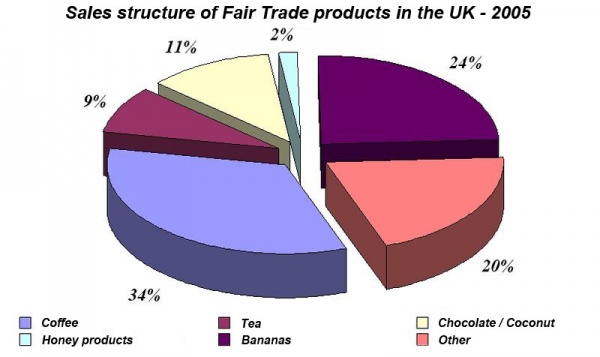 Unlike other Fairtrade products, coffee is in high demand and is used by the majority of consumers in large quantities. But more importantly, coffee is one of the few fair trade products that are better than the same items produced on plantations of large corporations. Coffee is better if grown at a higher altitude, in the shade of a tree, and if harvested when ripe. It is almost impossible to establish a plantation on higher altitudes simply because it requires more or less flat terrain, so that machines could successfully be used on it. In addition, it is not feasible to plant trees on plantations so coffee could be grown in the shade because it denies access to machines. Also, coffee harvesters are unable to collect only ripe coffee berries. They reap all, so in the bags could be found a considerable amount of immature coffee which significantly affects the flavor. For most small coffee plantations, from which comes about 65% of world production, none of the preceding presents a problem. Large corporations have supplanted many small producers of coffee from the valleys and plains, leaving them only the remaining land in the high mountains which results in good quality of coffee. Since all is processed by hand, it is not a problem to have coffee left in the shadows and to pick only ripe berries.
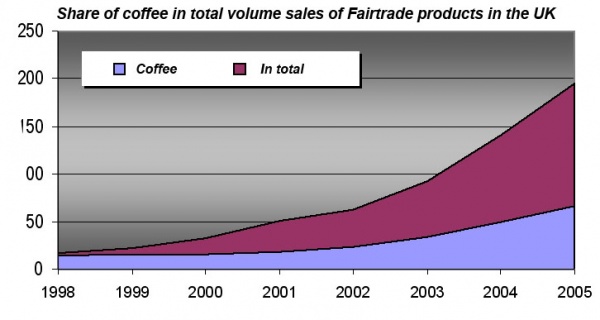 Market changes came also in favor of Fairtrade producers. Demand for quality grain has increased, especially due to changes in the consumption of coffee. Coffee sales through supermarkets in the U.S. market declined relatively compared to sales of specialized coffee chains (Coffee to go) like Starbucks. These chains just need all of their coffee flavors, in order to create special mixtures, and the price here is much less important than it is the case with the sale through the supermarkets. Large plantations are not able to deliver not nearly as high quality coffee as it can be done by small producers organized in cooperatives. This opportunity was "grabbed" by fair trade organizations. On the other hand, small manufacturers had a strong incentive in the late eighties to work with Fair Trade organizations because then the price of coffee fell to a record low, well below the cost of production due to Vietnam's entry into production and significant progress in the technology of work on plantations in Brazil. During the nineties the world scale production of coffee jumped by about 17% while demand fell by almost 11%.
This was mainly caused by a drop in demand in the U.S. market. American consumers have switched to soft (fizzy) drinks as illustrated by the fact that the per capita consumption of carbonated beverages in 1970 was 23 gallons, while in 2000 average American drank as much as 53 gallons a year. In contrast, consumption of coffee per capita has declined from 36 to 17 gallons. An additional problem for the producers of coffee is also a tendency to drink more and more milder variations of this drink. It should be noted that the downward trend in coffee consumption is not a general worldwide phenomenon, especially not in Eastern Europe (as when it comes to tobacco products). In what situation coffee makers found themselves better illustrates Oxfam's report from the 2002.
Share the News